Jeff Park Explains Why Bitcoin Upside Stays Capped in 2025

- Bitcoin price remains range-bound as OG holders sell upside volatility for yield.
- IBIT options show rising upside demand, while native BTC options stay suppressed.
- Bitcoin’s falling price and implied volatility continue to mute directional moves.
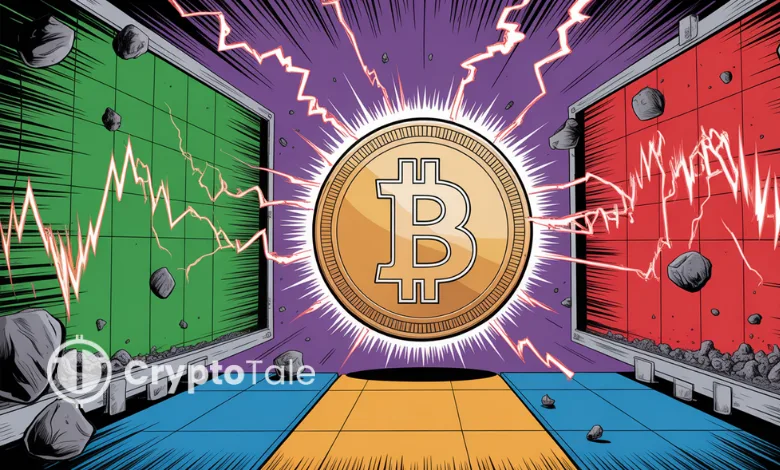
Bitcoin’s price continues to struggle with sustained upside in 2025, despite steady institutional inflows, as Bitwise Alpha’s head, Jeff Park, says the market structure explains why. In a recent Substack post, Park said ongoing supply from long-term Bitcoin holders and slowing demand from ETFs have created conditions that suppress volatility and limit price momentum. He added that without sustained upside volatility, Bitcoin remains trapped in a range even as spot Bitcoin ETFs attract consistent capital.
Park wrote that market conditions have stayed unfavorable for months due to overlapping pressures. “For those who have been listening to my commentaries,” he said, “the market structure has fundamentally been unfavorable for meaningful price gains.” He pointed to continued supply from OG Bitcoin holders, while ETF and digital asset trust demand has slowed at the margin.
At the same time, Park stressed the importance of higher implied volatility for meaningful price movement. “I hollered, ‘Give me volatility or give me death,’” he wrote, describing brief optimism during a November volatility uptick that later faded. Since then, implied volatility has fallen sharply, reinforcing range-bound trading.
Options Market Divergence Shapes Price Action
Park asked a direct question in his analysis: “Why is BTC not going up?” He answered by pointing to a sustained divergence between options markets tied to BlackRock’s IBIT ETF and native Bitcoin options on Deribit. According to Park, upside volatility premiums differ sharply once option durations extend beyond three months.
He explained that IBIT options show a positive call skew, with upside calls trading at a premium as maturities extend. In contrast, Bitcoin options remain negatively skewed, meaning upside calls stay cheaper than at-the-money volatility. “In other words,” Park wrote, “IBIT has a volatility smile, but BTC does not.”
Park said the divergence should not persist under equal capital costs, yet it continues to widen.
IBIT call skew slopes upward into the 120 to 150 percent range over longer durations. Bitcoin skew, meanwhile, remains downward sloping through similar maturities.
As a result, implied volatility has declined materially. Park noted volatility fell from roughly 63 percent in late November to about 44 percent. Lower volatility has muted directional price action and reduced breakout potential.
OG Bitcoin Supply Versus ETF Demand
Park attributed the skew gap to opposing positioning by different market participants.
ETF investors seek upside exposure through IBIT options, while crypto-native traders sell upside volatility aggressively. “Traditional market participants and crypto-native market participants are creating divergent flows,” Park wrote.
He rejected the idea that these flows cancel out. Buying IBIT and selling calls still adds net positive delta because ETF purchases represent new Bitcoin exposure. Most ETF inflows, Park said, bring fresh capital into Bitcoin for the first time.
OG Bitcoin holders operate differently. They already own Bitcoin, acquired many years ago, and sell calls against existing inventory. That activity adds a negative delta without creating new spot demand.
“This ‘BTC covered call’ strategy,” Park wrote, “explains the relentless continued selling from OG Bitcoiners.” He added that this behavior began well before ETF approvals and likely dates back to 2021. While some selling occurs in spot markets, options monetization adds another layer of pressure.
Related: Robert Kiyosaki Predicts BTC to Hit $175K to $350K in 2025
Gamma Dynamics and Market Structure
Covered-call selling affects more than just price direction. Park said it leaves market makers long gamma, encouraging hedging that reinforces mean reversion around key strikes. This dynamic suppresses volatility across longer timeframes.
IBIT options create a different effect. Upside call buyers impose negative gamma on market makers, which can support sharp upward moves. “When you look at the Jan LEAPs in IBIT,” Park wrote, “investors are mostly skewed to buying upside insurance.”
Park pushed back on claims that Bitcoin ETFs represent “paper Bitcoin.” He said ETFs have contributed both delta and vega to the market. “It’s actually the OG supply that is overwhelming on the margin,” he wrote.
He warned that regulatory moves allowing Bitcoin as collateral for derivatives could further dampen volatility. He said volatility may remain compressed unless the options supply declines or IBIT demand accelerates meaningfully.