
Tether Expands Bitcoin Holdings With A $800 Million Purchase


- Tether increased Bitcoin reserves on Jan 1 as prices softened and volumes slowed.
- Total holdings moved past 96,000 coins, while accumulation followed a fixed profit rule.
- Leverage clusters formed near 88,000 and 90,000 as the liquid supply continued to thin.
Crypto markets entered the new year with muted activity, but Tether moved early. On January 1, the stablecoin issuer added 8,888 Bitcoin to its reserves, a transaction valued close to $800 million at prevailing prices. The purchase pushed Tether’s total Bitcoin holdings beyond 96,000 coins, extending a strategy it has followed through both rising and cooling markets.
Bitcoin traded below $90,000 at the time, after posting strong gains earlier in 2025. Trading volumes slowed, and price movement narrowed. Even so, Tether continued accumulating without accelerating its pace. The firm has followed a fixed policy since May 2023, directing up to 15% of quarterly operating profits into Bitcoin.
Large holders have continued moving coins off exchanges. Liquid supply has tightened as a result. Demand has absorbed those withdrawals steadily, without sharp spikes, reflecting long-term positioning rather than short-term speculation.
Inside Tether’s Accumulation Pattern
Tether began purchasing Bitcoin in September 2022. At that stage, buying occurred without a formal public framework. That changed in May 2023, when the company announced a structured plan tied to quarterly profits. Since then, Bitcoin has been added every quarter.
Chief executive Paolo Ardoino confirmed that the latest accumulation totaled exactly 8,888.8888888 BTC. The precise figure followed a recurring pattern of symbolic “8888” purchases disclosed by the company. Ardoino shared the figure as part of routine reserve updates.
Arkham Intelligence’s blockchain analysts predicted that in the last quarter, Bitcoin transactions would amount to approximately $876 million. Accordingly, they indicated that a total of 9,850 BTC were bought, with discrepancies attributed to the timings and wallet unification. To be precise, Tether accumulates Bitcoin piece by piece throughout the quarter, frequently through Bitfinex withdrawals, and then at or just after the end of the quarter, it brings its funds into the main reserve wallet.
Market Performance and Liquidation Pressure
Bitcoin ended late 2025 under pressure. Prices dipped toward $88,000, producing a 23.07% quarterly loss, according to Coinglass data. That performance ranked as the second-worst fourth quarter on record, behind only Q4 2018.
On the one hand, Tether’s involvement in the market increased, while at the same time, the activity of some institutional buyers was either slowed down or put on hold. The company’s perceived average Bitcoin purchase price is close to $51,100. Before the end of 2026, the total unrealized profits were over $3.5 billion.
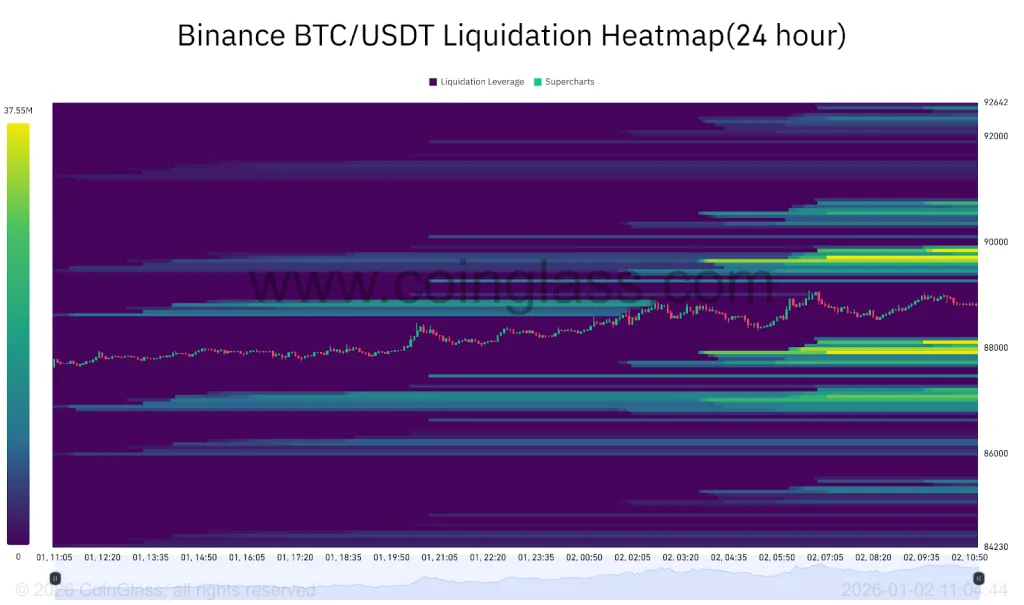
Source: Coinglass
At the same time, in the last 24 hours, Binance’s trading data reflected a strong concentration of leverage. Coinglass’s liquidation heatmaps indicated the presence of tall clusters in the range from $88,000 to $90,000. If the price returns to these levels, the zones will be subject to high liquidation risk. Additional layers were revealed above the market prices between $92,000 and $93,000, while thinner liquidity pockets were detected around $86,000 and $85,000.
Related: Tether-Connected Firms Acquire Peak Mining Ahead of Rumble Takeover
Reserves Beyond Bitcoin: Incoming Market Enlightenment
During the same period, Tether continued expanding reserve diversification. By the third quarter of 2025, the company held about 116 metric tons of physical gold. In September, Ardoino addressed claims that Bitcoin had been sold to fund gold purchases.
The speculation followed online claims that more than $1 billion in Bitcoin had been liquidated during the second quarter of 2025. Paolo Ardoino rejected those assertions, stating that Bitcoin holdings remained intact while gold reserves grew in parallel.
As Tether builds Bitcoin and gold side by side, reserve management is moving beyond simple balance-sheet optics. With liquidity tightening and accumulation continuing, how might this evolving reserve mix reshape market behavior as transparency deepens and capital positioning becomes clearer?