
Ethereum Adopts Austerity Framework to Safeguard Core Protocol


- Ethereum Foundation adopts five-year austerity plan to protect core protocol funding.
- Vitalik Buterin confirms 16,384 ETH withdrawal for gradual, long-term allocation.
- On-chain data shows easing sell pressure but weaker holder conviction amid volatility.
The Ethereum Foundation has announced a multi-year austerity program aimed at securing long-term financial sustainability while continuing to fund core protocol development, according to a public statement from co-founder Vitalik Buterin. The plan introduces controlled spending over five years and outlines how capital would be deployed gradually.
Vitalik Buterin confirmed that the Foundation has withdrawn 16,384 ETH for long-term use. The funds would not be spent at once and instead be allocated over several years. According to the statement, this approach is intended to reduce reliance on short-term market conditions. The Foundation said the move supports financial resilience without compromising development priorities.
Ethereum Foundation Aligns Austerity With Core Development Priorities
The framework was described as a period of “mild austerity.” It seeks to balance protocol development with financial discipline. The Ethereum Foundation stated that performance and scalability remain core objectives. Decentralization and network robustness were also identified as non-negotiable priorities.
The organization said its primary goal is long-term endurance. Safeguarding security, privacy, and user self-sovereignty remains central to its mission. The statement emphasized protecting the core blockchain layer rather than expanding aggressively. Access to the network must remain open and secure, according to the Foundation.
As part of the restructuring, Buterin said he would personally oversee initiatives that were previously managed as special projects. These initiatives would now fall under direct leadership rather than separate structures. The withdrawn ETH would be used to fund these efforts across multiple years.
The Foundation also disclosed that it is exploring secure and decentralized staking options. Any such mechanisms would aim to direct staking rewards toward long-term development. The statement did not confirm active deployment of staking capital.
Related: Vitalik Shifts Ethereum Endgame Toward Resilient Sovereignty
Ethereum Focus Shifts to Core Values as Market Volatility Persists
Buterin reiterated that the priority remains “Ethereum for people who need it.” The Foundation emphasized utility over expansion. Infrastructure that enables cooperation without centralized control was described as a guiding principle. Self-sovereignty was positioned as a core design goal.
The austerity phase was framed as a recalibration rather than a retreat. The Foundation contrasted its approach with technology models that equate success with dominance. According to the statement, long-term integrity depends on open and secure systems.
Ethereum has experienced renewed volatility following a sharp sell-off in January. As of press time, Ethereum is trading near the $2,800 level. The asset is down roughly 6–7% over the past 24 hours and about 9–10% year on year.
Price has moved back into the $2,700 to $2,800 range. This zone previously acted as a support area. Derivatives positioning has eased following recent liquidations. Open interest has declined as leverage has been reduced.
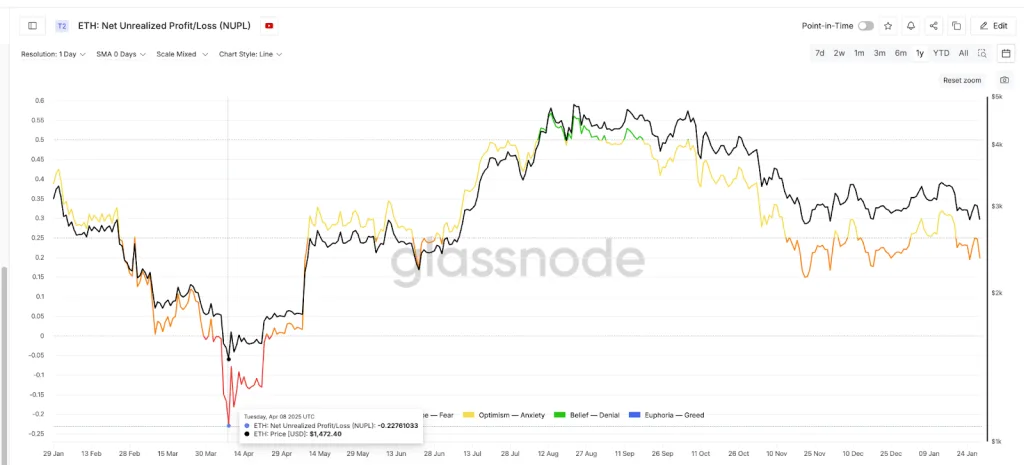
On-chain indicators are now being monitored closely. Net Unrealized Profit and Loss, or NUPL, is a key metric. It measures unrealized gains and losses across the Ethereum network.
Source: Glassnode
Ethereum’s NUPL currently sits near 0.19. This places the market in the “hope–fear” zone. Historically, this level has marked slowing sell pressure rather than definitive bottoms.
In June 2025, NUPL fell near 0.17 while Ethereum traded around $2,200. Price later surged toward $4,800 over the following month. The move represented a gain of more than 110%. That episode highlighted the metric’s sensitivity.
However, deeper market resets have occurred when NUPL turned negative. In April 2025, it dropped near −0.22. That level coincided with broad capitulation. Current readings remain well above that threshold.
Long-term holder activity is a mixed bag. The Hodler Net Position Change was positive in the month of January. This indicates continued accumulation. However, the pace has slowed.
Accumulation peaked around January 18 at roughly 338,700 ETH. By January 29, it had declined to about 151,600 ETH. That represents a drop of more than 55%. The data points to reduced conviction rather than widespread distribution.