
Bybit Stages Market Recovery in 2025 Despite Record Crypto Hack


- Bybit posted $1.5T trading volume in 2025 after recovering from the largest crypto hack.
- Its market share dropped to 6% in March then rose steadily as liquidity support stayed active.
- CoinGecko ranked Bybit second globally showing trust recovery after an exchange breach.
Bybit ranked second among centralized crypto exchanges in 2025 after recovering from a $1.5 billion hack, as trading volumes rebounded and market share steadily improved, according to CoinGecko data. The exchange processed $1.5 trillion in spot trading volume during the year and captured 8.1% of the market, research analyst Shaun Paul Lee said in a Thursday report. The recovery followed a February 2025 cyberattack, the largest crypto hack on record, which initially cut Bybit’s market share sharply before a gradual rebound through the rest of the year.
Bybit’s Recovery After the February Hack
The February attack targeted Bybit’s cold wallet infrastructure and resulted in the loss of $1.5 billion worth of Ether, according to details cited in the CoinGecko report. Investigators linked the breach to North Korean attackers, making the incident the largest known theft in the crypto sector to date.
In the weeks after the hack, Bybit’s market share dropped to 6% in March from 10% in February, reflecting immediate user caution and reduced trading activity. Still, the research said Bybit kept withdrawals open and honored all user transactions during the crisis, which helped stabilize activity.
Bybit CEO Ben Zhou also appeared publicly to address concerns and said the exchange held enough reserves to cover losses and planned to secure liquidity through external support. CoinGecko noted that these measures supported a slow recovery, allowing Bybit to regain trading volume and user confidence across 2025.
Market Position by December 2025
By December 2025, Bybit ranked as the second-largest centralized exchange by spot trading volume, according to CoinGecko. The exchange recorded $90.0 billion in spot volume during the month and held a 9.5% market share.

That figure marked a 16.7% decline from November, when Bybit posted $108.1 billion in volume, reflecting weaker overall market conditions. Despite the monthly drop, CoinGecko said Bybit maintained its second-place position for the year overall.
Shaun Paul Lee wrote that Bybit “clawed its way back to the top” and “slowly gained back its dominance throughout 2025.” The data positioned Bybit behind Binance but ahead of other major competitors in total annual activity.
Exchange Competition and Industry Context
Binance remained the largest centralized exchange in December 2025, holding 38.3% of total spot trading volume. Its trading volume fell from $609.0 billion in November to $361.8 billion in December, a 40.6% decline tied to broader market weakness. The data attributed the downturn to bearish sentiment following a major liquidation event on October 10.
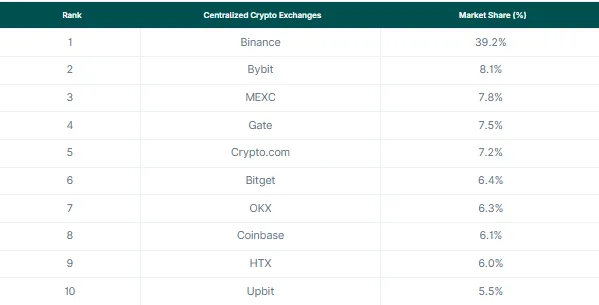
For the full year, Binance processed $7.3 trillion in volume and controlled 39.2% of the top ten exchanges’ total activity, which reached $18.7 trillion. However, Binance’s annual volume slipped 0.5% year on year, showing limited growth despite its market leadership.
MEXC ranked third in December with $86.0 billion in spot volume and a 9.1% market share, CoinGecko said. It also recorded the fastest growth in 2025, with trading volume rising 90.9% year on year to $1.5 trillion, up from $766.7 billion in 2024.
Related: Circle and Bybit Advance Global Stablecoin Adoption With USDC
CoinGecko linked MEXC’s growth to its zero-fee spot trading policy, which attracted high-frequency traders and retail users. Overall, six of the top ten exchanges saw volume growth in 2025, while total top ten trading volume rose 7.6% for the year.
Immunefi CEO Mitchell Amador said that nearly 80% of hacked projects never fully recover due to operational breakdowns and lost trust. Against that backdrop, the data raises a key question: can crisis response and liquidity management determine which exchanges survive major security failures?