
Bitcoin Halving Theory Meets 2026 Market Liquidity Pressure


- An X analyst identified Bitcoin’s halving cycle as a stable eigenmode in log space.
- SSA and DMD isolated a 4.19-year cycle around Bitcoin’s long-term power law path.
- Crypto research linked Bitcoin’s 2026 decline to tighter liquidity and wider macro strain.
Bitcoin’s four-year halving cycle returned to focus after X analyst @Giovann35084111 said advanced signal analysis found it as a core pattern in Bitcoin’s price behavior. At the same time, reports indicate that Bitcoin fell from its $127,000 peak in October 2025 to a $60,000 floor in under five months as liquidity tightened and risk appetite faded. Together, those views frame the current downturn as both a mathematical cycle and a macro-driven selloff.
Analyst Says Eigenvalue Decomposition Exposed a Core Cycle
On X, @Giovann35084111 described Bitcoin price as a complex signal made of several underlying patterns. The analyst said eigenvectors act like “fundamental notes” inside that signal and rank those patterns by importance. The analyst said the work used Singular Spectrum Analysis in log space rather than linear space. That choice mattered because Bitcoin moved from about $0.05 to $125,000 across six orders of magnitude.
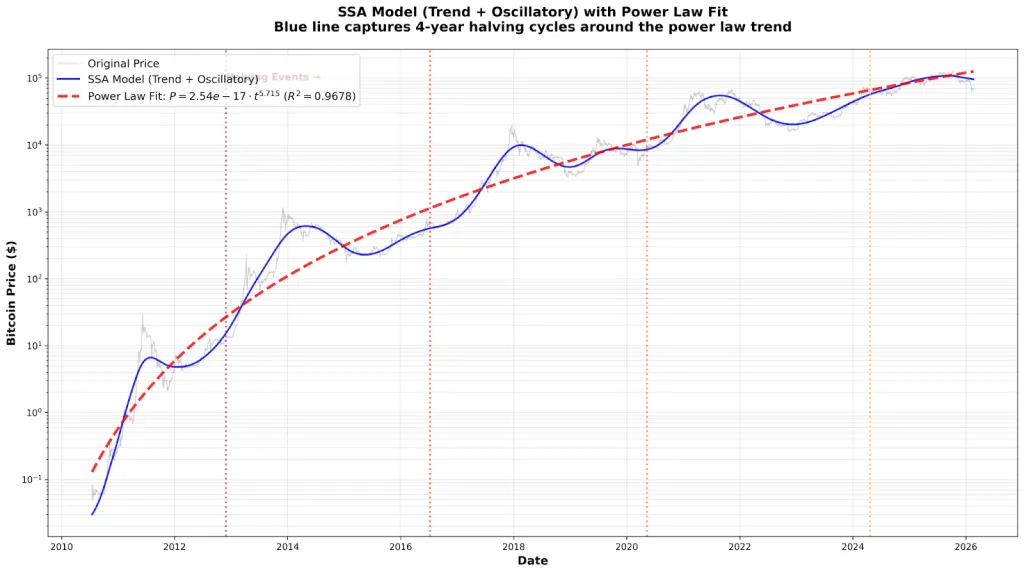
From there, the analyst said the price history was turned into a trajectory matrix and then decomposed with Singular Value Decomposition. In that framework, Eigenvector 1 captured 98.70% of the variance and represented a power law.
The post said that the dominant mode showed a price proportional to time, raised to 5.7. The analyst called that pattern Bitcoin’s “base note” and its fundamental attractor. Next, the analyst said Eigenvectors 2 through 6 accounted for 1.29% of variance and captured oscillations around the trend. Then Dynamic Mode Decomposition extracted the Koopman eigenvalues tied to those oscillations.
According to the post, Modes 5 and 6 showed a period of 1,530 days, or 4.19 years. The analyst linked that frequency to Bitcoin’s halving cycle and wrote, “The 4-year cycle isn’t just a coincidence or narrative.”
Log Space, Reconstruction, and the Critical-System Claim
The analyst said the detected oscillation had an eigenvalue magnitude of 0.9985. That figure suggested a slightly decaying but stable pattern around the broader trend. The post also tied the result to renormalization group theory. In that explanation, Bitcoin behaves like a critical system near a phase transition, with a power law fixed point and log-periodic oscillations.
The analyst argued that linear space buried the four-year cycle in noise. By contrast, log space made the cycle visible because halvings affect price through percentage changes rather than simple additive moves.
To test the structure, the analyst reconstructed Bitcoin’s price dynamics with six eigenvectors. The post said the reconstruction produced an R² of 0.9678 and described the outcome as stronger than the raw data.
The analyst then wrote, “The math works. The physics checks out.” The post’s bottom line said Bitcoin’s power law and four-year cycle are “fundamental eigenmodes of a complex dynamical system.” If the cycle remains intact, does the latest drawdown reflect breakdown or reset?
Reports Point to Liquidity, Not Theory, for 2026 Drop
CoinDesk described the first quarter of 2026 as a shaky start after Bitcoin’s October 2025 all-time high. The report said the drop to $60,000 looked severe, yet argued the market may be doing what it needs to build a stronger cycle.
The report said crypto usually absorbs heavy selling when macro conditions weaken, geopolitical tensions rise, and traditional markets slide. It listed elevated counterparty risk, tight liquidity, weak technical trends, fading ETF inflows, and stress in credit and banking markets.
Researchers also said crypto still trades mainly on global liquidity conditions despite wider adoption narratives. When liquidity expands, digital assets tend to rally, and when liquidity contracts, they often fall sharply.
Several forces now appear to be pulling liquidity from the system, according to the report. The Federal Reserve continues to reduce its balance sheet, while seasonal tax payments drain liquidity from the Treasury system.