
Bitcoin Hash Rate Rises as Miner Profit Pressure Deepens


- The BTC hash rate rose as the price stayed below its peak, widening the network value gap.
- CoinShares found that older mining rigs struggled as costs rose and margins shrank.
- Network strength held firm even as miners sold reserves and financial pressure built.
Bitcoin’s mean hash rate kept rising even as the asset traded below its recent peak, according to a Glassnode chart shared on X by analyst Michael van de Poppe. The chart showed network strength climbing past 1.1 zettahashes per second in 2025 and nearing 1.3Z before a modest pullback into 2026. At the same time, CoinShares reported that many miners faced tighter margins, rising production costs, and negative cash flow in late 2025.
Hash Rate Rises While Price Pulls Back
The Glassnode chart tracked two long-term trends. The orange line showed Bitcoin’s mean hash rate rising from near zero in the early 2010s to above 1.1Z by 2025. It later approached 1.3Z before easing slightly. Meanwhile, the black price line moved from below $1 in Bitcoin’s early years to above $100,000 near the latest cycle top. After that, the price slipped, yet the network’s computing power kept climbing.
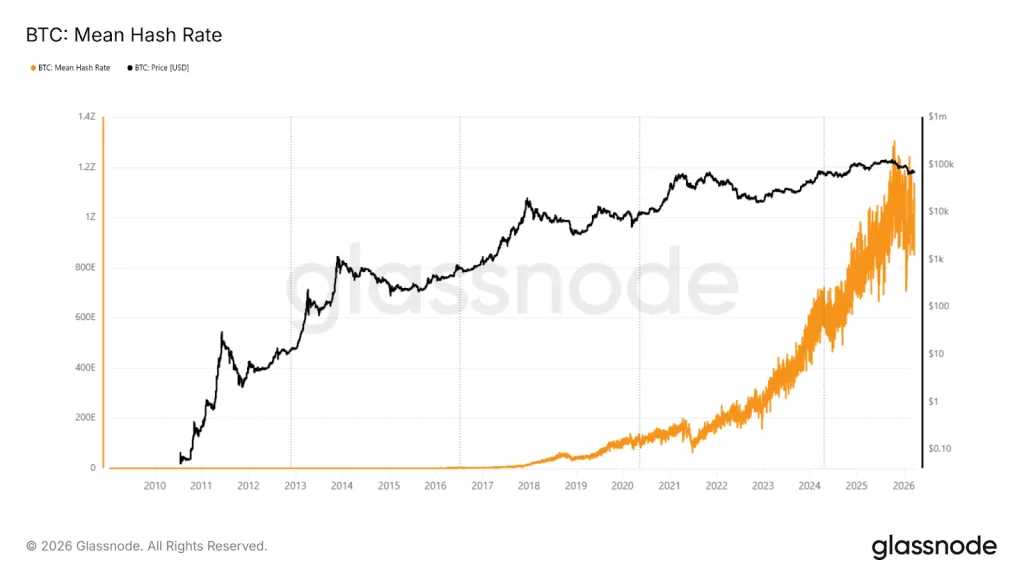
Van de Poppe used that divergence to challenge claims about AI disrupting Bitcoin mining. In his X post, he wrote, “‘AI will kill #Bitcoin, because data centers will stop mining Bitcoin’. Absolutely bullshit.”
He said the narrative gained traction because it matched fear during weaker market periods. He also said Bitcoin was down “a mere 20% from the peak” and noted that previous bear markets also showed downward ticks. He added that hash rate had risen lately while price kept falling. Can Bitcoin mining be fading when the network keeps adding computational power at a historic pace?
Research Details: Pressure on Mining Economics
While the network expanded, CoinShares described growing financial pressure across the mining sector. The firm said miners using mid-generation hardware below the S19 XP faced negative cash flow unless power costs stayed below $0.05 per kilowatt-hour.
That cost structure left roughly one-sixth to one-fifth of global mining capacity below breakeven. As a result, older and less efficient operators faced the strongest squeeze.
CoinShares also said the weighted average cost of production for publicly listed miners reached $79,995 per Bitcoin in the fourth quarter of 2025. The report linked that increase to higher electricity costs, stronger network difficulty, and added depreciation from AI and HPC infrastructure.
At the same time, hash prices stayed compressed. CoinShares recorded three straight negative difficulty adjustments in late 2025, a pattern it said had not appeared since July 2022 and pointed to miner capitulation.
Legacy S19-series machines faced added strain during winter. CoinShares said higher seasonal energy costs and ERCOT grid curtailments increased uneconomic mining hours and pushed more operators toward AI and HPC workloads. Even so, CoinShares said the network hash rate remained resilient. It peaked near 1,160 EH/s in October 2025, then fell about 10% by December and early 2026 as uneconomic operations stopped and inspections hit Xinjiang, China.
Related: Bitcoin Hashrate Drops as Miner Stress Builds: VanEck Data
By early March 2026, CoinShares said the network had stabilized near 1,020 EH/s. The firm said miners with cheap power, state backing, or next-generation ASICs still operated profitably, while publicly listed miners sold more Bitcoin from treasury holdings.
The report named Core Scientific, Bitdeer, and Riot among firms that liquidated notable treasury amounts. In turn, Van de Poppe argued that the disconnect between price and hash rate “provides an opportunity” because Bitcoin looked undervalued against what he called fair price.