CLARITY Act Faces Hurdle as Coinbase Rejects Yield Compromise

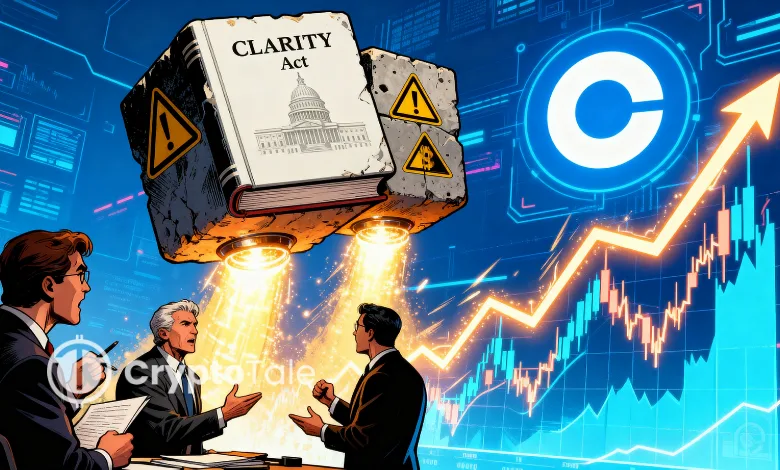
- Coinbase opposed new yield terms, disrupting Senate momentum on the CLARITY Act.
- Stablecoin rewards remain the core fault line dividing crypto firms and banks.
- Lawmakers now face a narrowing window to advance the bill before late April.
The Senate’s latest attempt to move crypto market structure legislation forward hit resistance this week after Coinbase opposed a new compromise on stablecoin yield language. The objection landed as lawmakers had signaled that negotiations were nearing a breakthrough, making the company’s position a fresh complication for a bill already under time pressure.
According to reporting cited by Punchbowl News, Coinbase representatives told Senate offices on Monday that they could not support the latest version of the compromise. The exchange raised concerns about provisions tied to stablecoin yields, an issue that has become one of the most contested points in the broader push to define how US regulators should oversee digital assets.
Yield Language Reopens a Fragile Senate Fight
The dispute centers on whether third parties, including exchanges, should be allowed to offer yield on stablecoin balances. A proposal circulated earlier this week would reportedly block such payments, reflecting pressure from banking groups that view the practice as a threat to traditional deposits.
That fight has weighed on the Senate’s work for months. Banking interests argue that exchange-based yield products create a loophole around earlier restrictions on issuers and could accelerate deposit flight from the banking system. Crypto firms, meanwhile, have pushed back, saying those risks are overstated and that the banking sector is protecting its own turf.
The latest setback matters because the same issue already disrupted momentum once before. Initially, Coinbase withdrew support for the bill in January shortly before the Senate Banking Committee indefinitely postponed a markup that could have advanced the legislation. Similarly, this week’s resistance did not appear as severe, but it still disrupted the sense that negotiators were close to a deal.
Brendan Pedersen of Punchbowl News reported that talks remain fluid and ongoing. In the meantime, Republican Senator Thom Tillis and Democratic Senator Angela Alsobrooks are leading the latest effort to advance the bill, even as agreement remains incomplete.
Why Coinbase Is Pushing Back
Based on reports, the newest draft would ban yield on passive stablecoin balances and on anything considered economically equivalent to interest. It would also direct the SEC, CFTC, and Treasury to define which rewards remain permissible within 12 months.
That timeline is central to Coinbase’s concern. The company cannot clearly estimate how future rules would treat one of its largest revenue streams while those standards remain undefined. The uncertainty is not theoretical. Coinbase generated $1.35 billion in stablecoin revenue in 2025, equal to about 19% of total revenue.
That figure marked a sharp increase from $911 million a year earlier. In the fourth quarter alone, Coinbase recorded $364 million in stablecoin revenue, during a period that also included a net loss of $667 million and total revenue of $1.78 billion. Those numbers show why any restriction tied to stablecoin rewards carries material business consequences.
Industry Divisions Are Now in the Open
Notably, the reaction across the crypto industry was swift and divided. Some users and industry voices on X publicly criticized CEO Brian Armstrong and called for a boycott of Coinbase after news of the company’s position emerged.
Others took a more strategic view. Delphi Ventures executive Tommy Shaughnessy argued that the industry still needs legislation before political conditions change, even if the compromise is imperfect. His position reflected a broader divide among crypto stakeholders, with some describing the proposal as workable while Coinbase continued to object.
Coinbase’s influence also extends beyond the policy text itself. The exchange is described in the source material as one of the largest crypto lobbyists in Washington and a top funder of the Fairshake super PAC network, giving it leverage few firms in the sector can match.
Related: SEC Signals Tokenization Exemption Could Arrive Within Weeks
Time Is Becoming Part of the Story
The timing now looks increasingly important. Republicans are pushing to pass the bill before the midterms, when a shift in congressional control could stall the effort. The House already passed its version, the CLARITY Act, in July, but Senate negotiators are still trying to bridge differences around stablecoin treatment.
The White House, on the other hand, has reportedly hosted at least three meetings between banking and crypto interests in search of a compromise. However, none has produced a final agreement. Assuming the Senate Banking Committee cannot advance the measure before late April, the bill could begin to lose its remaining runway.For now, the CLARITY Act remains alive, but its path has narrowed again. Coinbase’s latest objection did not kill the talks, yet it underscored a stubborn reality: stablecoin policy remains the fault line that could determine whether the Senate reaches a deal at all.