
Gold Hits Record Highs as Investors Flee Risk, Crypto Slips


- Gold hits record highs as investors rotate into safety amid global macro uncertainty.
- Gold adds value rivaling Bitcoin’s market cap as crypto weakens on rising volatility.
- Short-term risk aversion dominates markets while Bitcoin struggles to fully recover.
Gold surged to a new all-time high as global markets showed clear signs of rising risk-off sentiment. The precious metal added roughly $1.65 trillion in market value within a single day. At the same time, Bitcoin and broader crypto markets declined, reflecting a short-term shift in liquidity.
Gold’s spot price climbed to $5,570.7 per ounce over the last 24 hours. The move pushed gold’s total market capitalization above $37.5 trillion. Market data showed the daily increase rivaled Bitcoin’s entire market value. The rally marks as one of the strongest single-day moves in gold’s history.
Gold Rally Signals Risk-Off Rotation
Geopolitical risks and economic uncertainty continued to rise prompting investors to enhance exposure to gold. Capital allocation decisions were also affected by sticky inflation as well as changes in interest rate expectations. These factors promoted portfolio changes of volatile assets to defensive ones.
The rally extended a broader multi-month trend in precious metals. Market participants often associate this trend with concerns over currency debasement. Higher government debt and loose fiscal policies reinforced those fears. As a result, gold attracted steady inflows from both institutions and retail investors.
Bitcoin, however, was not able to sustain the upward trend in the same period. The cryptocurrency fell due to the traders decreasing speculative positions. Broader crypto markets recorded increased liquidations during the pullback. These liquidations implied leveraged positions came under pressure on increasing volatility.
Bitcoin’s decline contrasted sharply with gold’s strong performance. Some investors previously expected Bitcoin to mirror gold during uncertain periods. However, recent price action showed Bitcoin remains sensitive to macro liquidity cycles. Short-term flows moved away from crypto toward traditional defensive assets.
Bitcoin Weakens as Sentiment Diverges
Bitcoin’s recent weakness followed an earlier market crash in October. That event wiped out more than $19 billion in leveraged crypto positions. Since then, Bitcoin has struggled to regain sustained upward momentum. Traders adopted a more cautious approach as volatility remained elevated.
The divergence becomes clearer over longer timeframes. Over the past five years, gold rose roughly 173 percent. Bitcoin gained about 164% over the same period. This performance gap challenged the idea that both assets move in tandem.
Sentiment indicators also reflected the growing divide. The Crypto Fear and Greed Index currently stands at 26. That reading places the crypto market firmly in fear territory. In contrast, gold sentiment reached extreme levels of optimism.
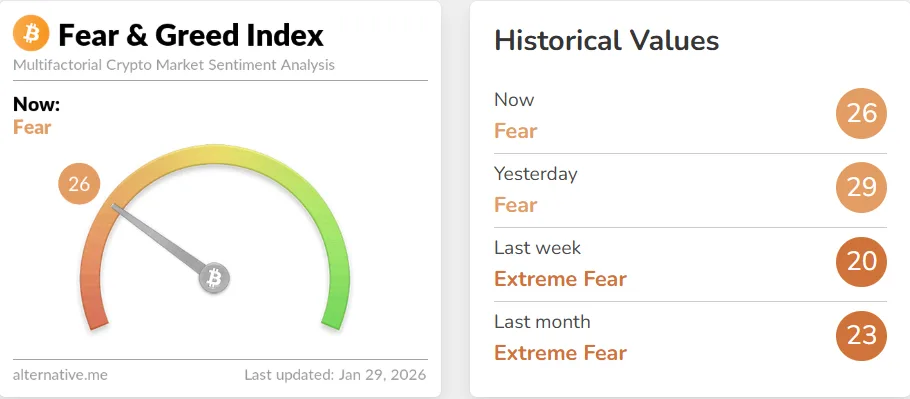
Source: Alternative
JM Bullion’s Fear and Greed Index for gold reached 99. The reading signals intense bullish sentiment among gold investors. Market watchers noted the sharp contrast between the two asset classes. The difference highlights changing investor priorities during uncertain conditions.
Related: BTC Crash Triggers $150B Crypto Wipeout as Gold Hits Record
Despite the short-term weakness, institutional confidence in Bitcoin remains. A recent Coinbase survey showed strong long-term conviction among institutions. 71% of surveyed investors viewed Bitcoin as undervalued. That view applied when Bitcoin trades between $85,000 and $95,000.
Also, approximately 80% indicated a desire to hold or purchase more after declines. Those reactions indicate that long-term positioning is not lost amid volatility. However, near-term liquidity conditions continue to favor safer assets. Gold currently benefits most from this defensive market stance.
For now, the rally in gold sends a clear signal across global markets. Caution dominates as investors brace for potential economic and policy shocks. Markets continue to adjust as uncertainty shapes capital flows.