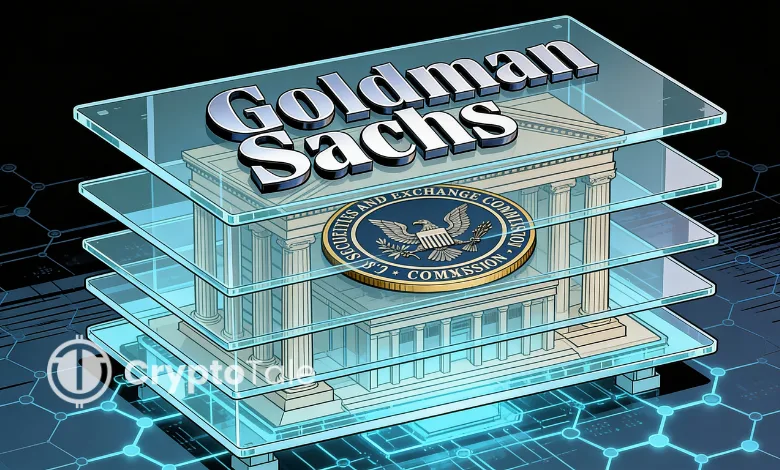
Goldman Says Regulation Fuels Next Institutional Crypto Cycle

- Goldman Sachs says regulatory clarity now drives the next wave of institutional crypto adoption.
- SEC policy reversal and US structure bills are lifting barriers that slowed crypto access.
- ETFs, tokenization, and stablecoins show how regulation expands crypto use beyond trading.
Regulatory clarity is emerging as the main catalyst for the next phase of institutional crypto adoption, according to Goldman Sachs. The bank says institutions now focus less on price cycles and more on clear rules that support long-term integration.
In a report released Monday, Goldman said improving regulation reshapes how large financial firms approach digital assets. The shift marks a move from cautious experimentation toward structured participation across markets and infrastructure.
Analysts led by James Yaro said regulatory uncertainty has remained the largest barrier for institutional entry. However, they noted that the U.S. policy environment has changed rapidly over the past year.
Goldman said this change favors infrastructure providers more than trading-focused firms. These include custody services, tokenization platforms, and compliance-driven market operators. The bank added that crypto use cases now extend well beyond spot trading. Institutions increasingly explore settlement, payments, and asset issuance through blockchain systems.
U.S. Policy Shift Alters Institutional Outlook
The report linked this shift to political and regulatory changes in Washington. After President Donald Trump took office, leadership changes followed at the Securities and Exchange Commission.
Paul Atkins became SEC chair after confirmation last year. Under his leadership, the agency stepped back from years of aggressive enforcement against crypto firms. The SEC dropped most pending cases and withdrew from several active court disputes. Goldman said this move reduced legal uncertainty for both buy-side and sell-side institutions.
Trump identified crypto industry growth as a policy priority. Atkins echoed that stance, despite the SEC’s independent regulatory role.
Meanwhile, draft market structure bills have entered Congress. These proposals aim to clarify oversight of tokenized assets and decentralized finance platforms. The bills also define jurisdictional boundaries between the SEC and the Commodity Futures Trading Commission. Goldman said this clarity remains essential for institutional capital deployment.
The bank noted timing remains critical. Passage during the first half of 2026 could prevent delays tied to U.S. midterm elections later that year. Survey data from Goldman showed 35% of institutions cite regulatory uncertainty as their top concern. Another 32% named regulatory clarity as the strongest adoption catalyst.
Infrastructure Gains as Allocations Remain Modest
Despite rising interest, institutional exposure to crypto remains limited. Goldman estimated asset managers allocate about 7% of assets under management to crypto. However, 71% of surveyed institutions said they plan to increase exposure within the next year. Goldman said this gap signals room for structural growth.
Adoption has already expanded through familiar financial products. Bitcoin exchange-traded funds reached about $115 billion in assets by late 2025. Ether ETFs have also grown, surpassing $20 billion in assets. Goldman said ETFs reduced friction for institutions entering digital assets.
Hedge fund participation has also increased. A majority now hold crypto and plan further allocation growth. Beyond ETFs, Goldman highlighted tokenization as a key expansion area. Institutions now view tokenized assets as efficiency tools rather than speculative products.
Related: How Institutions Took Over Crypto During 2025’s Slump
The report also pointed to decentralized finance and stablecoins. Stablecoin legislation passed last year clarified reserve and oversight rules. That clarity helped the stablecoin market grow toward a $300 billion capitalization. Goldman said institutions see stablecoins as settlement infrastructure.
Additional regulatory changes have lowered entry barriers. These include updates to bank supervision and the rollback of restrictive custody accounting rules. New digital-asset bank charters have also emerged. Goldman said these steps allow traditional firms to engage without structural conflicts.
The firm concluded that regulation now drives adoption more than market cycles. Institutions appear positioned for deeper crypto integration under clearer rules.