Peter Schiff Slams Bitcoin as a ‘Shitcoin,’ Dares Michael Saylor to Debate


- Peter Schiff renewed his attack on Bitcoin and challenged Michael Saylor to debate.
- Schiff said Bitcoin gained 12% in five years, trailing gold, silver, Nasdaq, and S&P 500.
- Saylor cited August 2020 data showing Bitcoin as the top-performing major asset.
Peter Schiff renewed his public attack on Bitcoin on Sunday through posts on X. He challenged Michael Saylor and questioned the asset’s long-term record. The exchange reopened a familiar dispute over returns, timeframes, and whether supporters still have data on their side.
Schiff argued that the token has not delivered the superior gains many backers still promise. He said its five-year rise was 12%, while gold gained 163% and silver climbed 181%. He also pointed to gains of 57.4% for the Nasdaq and 59.4% for the S&P 500.
Schiff Bases His Case on a Five-Year Window
Schiff said his comparison covered a full five-year period, not a later starting point chosen after a market low. He argued that changing the start date makes the cryptocurrency look stronger than it is.
Based on the report, his window begins around April 2021, when the asset traded near its earlier peak of about $69,000. That period includes the deep 2022 market decline and the slower recovery seen through 2024 and 2026.
At the time of writing, Bitcoin was trading at $69,031. Schiff used that figure to argue that the asset lagged major indexes and precious metals over the period. He then called it a “shitcoin” and challenged Saylor to debate him publicly.
Saylor Pushes Back With a Different Benchmark
Saylor pushed back by saying performance depends on the period being measured. He shared a chart showing BTC with a 36% annualized return since August 2020, placing it ahead of other major assets.
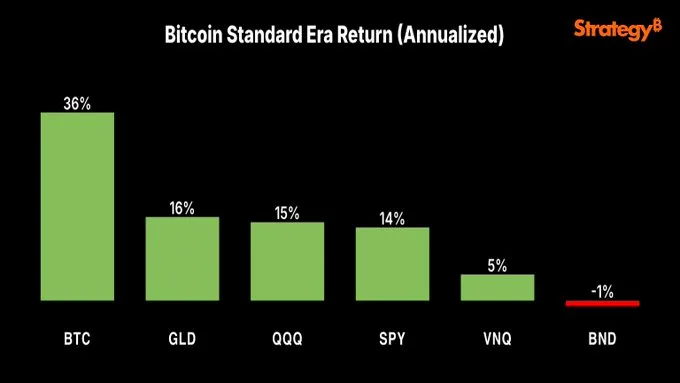
In that chart, gold returned 16%, while QQQ posted 15% and SPY returned 14%. VNQ showed 5%, and BND posted a negative 1%. Saylor said longer timeframes present a clearer picture and widen the performance gap.
The disagreement, therefore, centered on measurement as much as returns. Schiff used a peak-era entry point, while Saylor, on the other hand, relied on a later date tied to Strategy’s Bitcoin plan. Meanwhile, as of this writing, Strategy held 762,099 BTC, making it the largest corporate holder of the asset.
The company’s average purchase price stood at about $75,699 per coin, and because the market price remained below that level, the holding was still underwater. That gave Schiff more room to challenge long-term holding arguments, even as Saylor defended the broader performance record.
Related: Ethereum Foundation Nears 70,000 Staked ETH as Price Defends $2,000
Schiff’s History Keeps the Debate Alive
Data compiled by bitcoindeaths.com shows Schiff has made at least 22 public statements declaring Bitcoin “dead” since 2011. That is the highest total among critics tracked by the site. His first recorded call came when the asset traded near $17.

His most recent “dead” calls came in early 2026, when prices ranged from $60,000 to $65,000. Those warnings included a projected 85% crash. Even so, the asset has risen more than 4,110 times since Schiff’s first recorded call.
The same data ranks Steve Hanke second with 10 calls, while Warren Buffett and Nouriel Roubini each have eight, and Jamie Dimon has seven. Overall, the latest Schiff-Saylor clash combined two old disputes: how to measure returns and how often critics have been wrong.