
Starknet Unveils STRK20 for Compliant Private Asset Deals


- STRK20 brings native token privacy to Starknet without disrupting wider DeFi access.
- Starknet says shielded transfers can stay fast, cheap, and fully ready for compliance.
- Encrypted audit access could expand stablecoin use among larger regulated institutions.
Starknet is developing a privacy framework that allows teams to launch shielded stablecoins and other digital assets while preserving regulatory compliance. The capability, called STRK20, is under development by StarkWare and is expected to launch on Starknet later this year. The framework introduces token-level privacy for assets on the Ethereum Layer 2 network while keeping them compatible with decentralized finance applications.
Developers say the system will allow transactions and balances to remain confidential without sacrificing speed, cost efficiency, or compliance features.
Starknet Introduces Token-Level Privacy for ERC-20 Assets
The STRK20 framework targets privacy for tokens issued on Starknet, an Ethereum Layer 2 network. Developers designed the system to work across ERC-20 tokens, the standard used for most fungible assets on Ethereum.
StarkWare said the capability could extend privacy functionality to Ethereum-based assets and decentralized finance platforms. The team shared details in a statement provided to The Block. StarkWare said, “This will enable Ethereum and ERC20s to leverage this privacy capability, including for private DeFi.”
Developers explained that the framework embeds privacy features directly at the token level. As a result, projects do not require additional infrastructure to use the system.
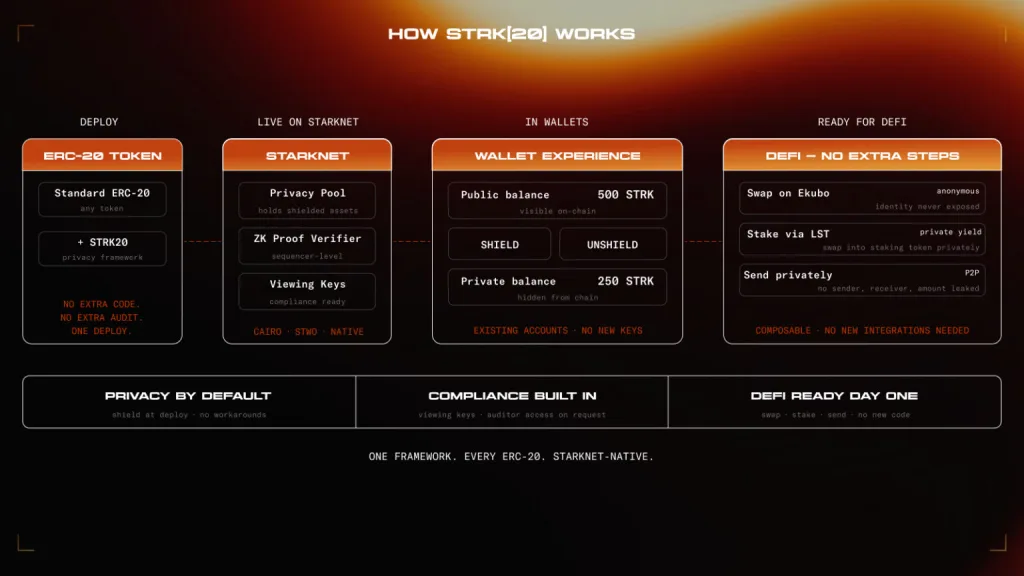
The team also outlined performance targets for the privacy feature. Transactions using the system are expected to settle in less than five seconds. Developers also estimate costs below twenty cents per transaction.
These targets aim to make privacy features practical for financial applications on blockchain networks. StarkWare said the framework supports confidential activity while maintaining compatibility with existing decentralized finance tools.
STRK20 Adds Confidential Transfers While Keeping Public Execution
Bitcoin and Ethereum blockchains operate with full transparency. Anyone can usually view wallet balances and transaction histories on public explorers. This design improves auditability and verification. Yet it also limits certain financial use cases because organizations may prefer confidentiality for sensitive transactions.
STRK20 introduces what Starknet describes as transaction-layer privacy. Under this model, asset ownership remains hidden while transactions still execute on a public network. Users can shield tokens into a private state and later transfer them confidentially. They can also return those tokens to a public state when required.
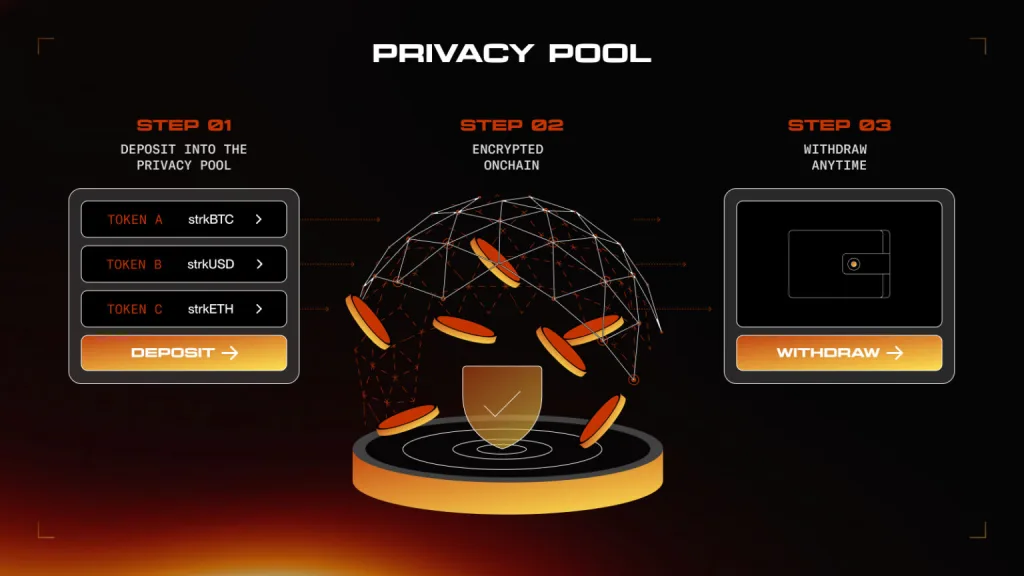
The framework keeps both private and public states tied to the same asset. That structure avoids splitting liquidity across different token versions and maintains compatibility with existing liquidity pools.
Eli Ben-Sasson, StarkWare chief executive officer and co-founder of Zcash, described the capability as a possible catalyst for institutional adoption. He said privacy for transfers, swapping, staking, and other decentralized finance activity could move stablecoin adoption “up about five gears.” If privacy and compliance can coexist, could confidential financial activity on public blockchains finally scale for institutional markets?
Starknet Plans Ecosystem Integrations and Compliance Features
Starknet developers have already planned early integrations within the network’s ecosystem. Ekubo Protocol intends to support privacy-enabled swaps once the system launches. The team is also exploring private staking for several assets. These include Bitcoin and the Starknet token within decentralized finance environments.
Starknet discussed compliance features in a blog post describing the design of the privacy pool. The network explained that users register encrypted viewing keys on-chain when they join the privacy pool.
The blog post stated, “If a regulatory request comes in, a designated third party auditing entity can decrypt that specific user’s key and trace their complete transaction history, forwards and backwards.”
Starknet explained that the design isolates access to the specific user under review. The blog post added that the mechanism protects other users from exposure during an investigation. The company wrote, “This is not a backdoor. It is a carefully scoped access mechanism that responds to legal requirements without exposing the entire pool.”
Related: Starknet (STRK) Soars with Strong Network Activity and TVL
Starknet further stated that the architecture allows privacy by default while still enabling legal oversight. The blog post concluded that this approach could make STRK20 suitable for institutions and enterprises. Earlier experiments within the ecosystem already explored privacy-focused Bitcoin use cases. Starknet introduced strkBTC earlier this year. The asset allows optional shielding for Bitcoin balances while still supporting decentralized finance participation.
Interest in privacy solutions continues to grow across the crypto industry. Public blockchains process trillions of dollars in yearly transactions. Yet anyone can view wallet balances and transaction histories on those networks. Starknet developers say privacy tools could allow users to pay, trade, and lend without revealing financial activity. The team also stated that the system aims to maintain compliance while improving blockchain usability.