The Future of Altcoins Looks More Like Nasdaq Than DeFi: Here’s Why

- VC-heavy token supply met thinner secondary liquidity, capping many 2025 altcoin gains.
- About 75 projects were funded each month in 2025, showing that Web3 capital did not disappear.
- Binance’s market-maker rules point to a more regulated, stock-market-style structure.
The structure of the digital asset market is shifting, with Altcoins increasingly exhibiting characteristics of traditional equity markets rather than those of early decentralized finance models. Data shared by analyst TVBee outlines how liquidity dynamics, venture capital behavior, and exchange oversight are reshaping market outcomes.
The report shows that during the May–August 2025 period, Bitcoin rose while its market share declined, signaling a classic altcoin expansion phase. However, the growth in total market capitalization did not translate into uniform price gains across individual tokens.
In TVBee’s framing, the issue was not the absence of capital altogether. It was where that capital had gone, and when it arrived.
A Crowded Pipeline Met a Thinner Market
The report traced much of the pressure back to 2021 and 2022, when venture capital funding flowed heavily into crypto’s primary market. That period produced a large number of projects and extended fundraising windows, far longer than the usual one- to two-month bursts seen in other cycles.
By the time many of those tokens reached generation events in 2025, the backdrop had changed. Liquidity in the secondary market had weakened. The result was a supply backlog hitting a market with less appetite to absorb it.
That imbalance helps explain why so many VC-backed names traded poorly even while overall altcoin capitalization rose. Selling pressure was relatively high, while buying support was not. The outcome was broad-based growth in paper value, without the sharp, token-level moves that typically define a more visible altcoin rally.
Funding Cooled, But It Did Not Disappear
TVBee’s data further suggested venture activity remained active through 2025, though at a more measured pace. On average, about 75 projects received funding each month. That was well below the excess seen in 2021, but still above the pace recorded in 2017 and 2018.
That distinction is critical, as it indicates a market that has not shut down but has become more selective. The report also cited total value locked across the network at $92.831 billion, roughly in line with levels seen in March and April 2021.
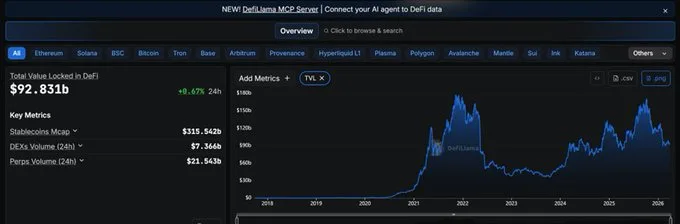
In other words, the broader Web3 economy still carries size, even if investor behavior has become more cautious. For Altcoins, that means the pipeline remains open, but it is no longer flooding the market at the same intensity.
Big Companies Are Already in the Room
The analysis also pointed to increasing overlap between Web3 and large technology or financial firms. Google was cited as a Hedera node operator and governing council member, alongside companies including IBM, Boeing, and Nomura Securities. It also integrated Hedera ledger data into BigQuery and supports tools for Midnight node deployment through Google Cloud.
Other examples followed a similar pattern. NVIDIA recently backed a joint effort involving Brev.dev and Akash. Microsoft developed ION, a second-layer decentralized identity network for Bitcoin. Telegram remains central to the TON ecosystem, while Sony has launched Soneium.
On the service side, projects tied to Altcoins are also being used beyond crypto-native circles. TVBee pointed to Bittensor, Aethir, VeChain, and Polkadot as examples of blockchain-linked networks serving AI, enterprise, or institutional use cases.
Related: Solana DeFi Exchange Drift Halts Services After $285M Exploit Scare
Exchanges Are Taking On a More Familiar Role
The clearest sign of a Nasdaq-style shift came from Binance’s March 25, 2026, market-maker guidance. The exchange identified five risk areas, including aggressive selling around unlocks, one-sided trading, shallow liquidity, and mismatches between volume and price.
It also laid out responses. Project teams were told to monitor market makers closely, follow token release schedules, disclose relevant information to the platform, and avoid arrangements that distort prices or liquidity. Binance, for its part, said it would continue monitoring trading behavior and act quickly against violations.
That does not turn crypto venues into stock exchanges overnight. Still, the direction is harder to miss. In TVBee’s account, Altcoins are moving toward a market where issuance is more selective, trading is more supervised, and exchanges play a larger role in shaping conduct. According to him, the DeFi-era image of unlimited token sprawl has not vanished, but it is no longer the whole story.