Trump Narrows Fed Chair Race to Warsh or Hassett Choice

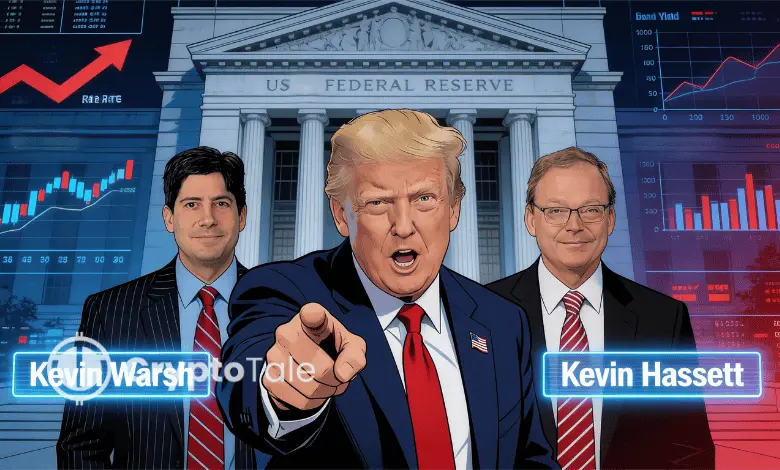
- Trump confirms that Warsh and Hassett remain the final contenders for the Fed chair role.
- Warsh backs lower rates after White House meeting with President Trump discussion.
- Hassett’s long service inside the Trump circle keeps him central to the decision process ahead.
President Donald Trump said Friday that he is concentrating on two candidates to lead the Federal Reserve next year as Jerome Powell’s term as chair approaches its scheduled end. Speaking to The Wall Street Journal, Trump named former Fed Governor Kevin Warsh and National Economic Council Director Kevin Hassett as the leading contenders. He said Warsh currently sits at the top of the list.
“Yes, I think he is,” Trump told the Journal. “I think you have Kevin and Kevin. They’re both great. I think there are a couple of other people who are great.” The comments came as markets watch closely for signs about the future direction of U.S. monetary policy. The Fed plays a central role in setting interest rates and guiding financial conditions.
Trump, as reported earlier by the Journal, confirmed that he met Warsh at the White House on Wednesday. During the meeting, Trump questioned whether Warsh would support cutting interest rates if confirmed. “He thinks you have to lower interest rates,” Trump said of Warsh. “And so does everybody else that I’ve talked to.”
With Powell’s chair term expiring in May 2026, the remarks mark the clearest signal yet of Trump’s short list for the position.
The Fed Interest Rates and the Powell Succession
Trump said the next Fed chair should consult with him on interest rate decisions. He noted that such coordination occurred more often in past decades. “Typically, that’s not done anymore,” Trump said. “It used to be done routinely. It should be done.” He added that he views himself as “a smart voice” on monetary policy.
Earlier this week, the Federal Reserve cut its benchmark interest rate by a quarter point. The new range stands between 3.5% and 3.75%, marking a three-year low. The decision produced three dissenting votes, the most since 2019. Two officials opposed any cut. A third, former Trump adviser Stephen Miran, supported a larger half-point reduction.
Trump has said in recent weeks that he had already settled on a preferred candidate. On Friday, he repeated that view while signaling that the decision remains open. “I think I have somebody that I like the best,” Trump said. “I like all of them, but I want to be careful.” He cited regret over advice that led to Powell’s selection in 2017.
Could the next Fed chair reshape how closely the White House and central bank interact on interest rate policy?
Related: Congress Urges SEC to Allow Bitcoin Inside 401(k) Plans Now
Trump on Final Interviews and Market Attention
Trump said he is holding a final round of interviews with top candidates, including Hassett. Treasury Secretary Scott Bessent is also involved in narrowing the field. Bessent has interviewed two current Fed governors appointed during Trump’s first term. The candidates include Christopher Waller and Michelle Bowman, according to the Journal.
“I like the people—all of the people I put on the board, I like,” Trump told the Journal when discussing the broader list of contenders. Hassett has drawn attention because of his long working relationship with Trump. He holds a Ph.D. in economics and has served in several senior advisory roles.
Hassett worked as a senior economic adviser from 2017 to 2019. He returned in 2020 during the COVID pandemic and became head of the National Economic Council in January. In a recent interview, Hassett downplayed betting market speculation that he is the favorite. “Trump makes his choice, and then he changes his mind, too,” he said at a Journal event.
Analysts cited by the New York Post noted that Trump has floated interest rate targets near 1% or lower. Such levels would mark a sharp change from recent Fed policy. Trump’s remarks come as investors, lawmakers, and global central bankers track who may guide U.S. monetary policy amid economic uncertainty.