
U.S. Crypto Rules Face Years of Delay as Politics Take Control

- TD Cowen claims that U.S. crypto market rules may pass in 2027, with effects by 2029.
- Political disputes over ethics and agency control continue to slow crypto lawmaking.
- The ongoing uncertainty may push crypto innovation listings and liquidity overseas.
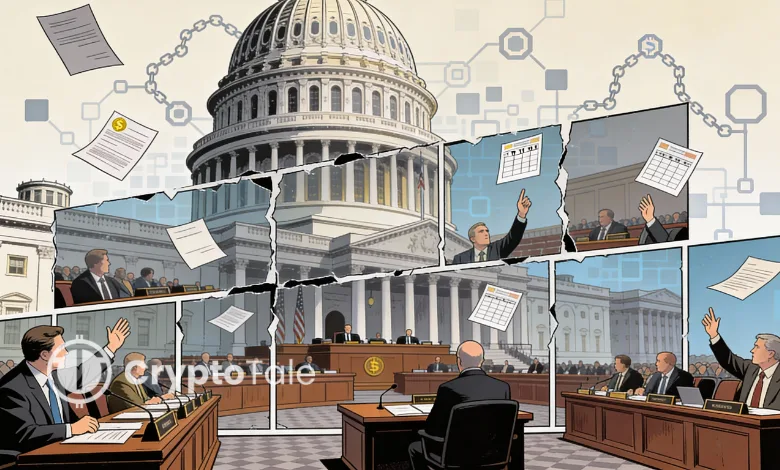
U.S. legislation designed to establish clear rules for crypto markets may face prolonged delays, with passage potentially pushed to 2027 and implementation extending into 2029, according to TD Cowen. The firm said political dynamics in Congress now outweigh market urgency, even as global crypto infrastructure continues to mature. Analysts warned that delays could deepen regulatory uncertainty for firms operating in the United States.
TD Cowen’s Washington Research Group said there remains a narrow path for a crypto market structure bill to pass this year. Still, the group said shifting political incentives make delays more likely. Democrats may see limited reason to accelerate talks if they believe control of the House could change after the 2026 midterm elections.
Managing director Jaret Seiberg said election outcomes remain uncertain, which could still encourage compromise. He noted that congressional staff have worked on technical language for months. That preparation, he wrote, allows for a deal to move quickly if political conditions align.
Seiberg added that time now favors a slower timeline. He said the bill’s most difficult issues fade if Congress passes it in 2027 and sets enforcement for 2029. Crypto firms, he wrote, would need to accept that presidential elections could shape final rules.
Political Frictions Shape the Legislative Timeline
Conflict-of-interest language stands as a major obstacle to faster progress. TD Cowen said Democrats are likely to seek provisions barring senior officials and their families from owning or operating crypto businesses. These restrictions, Seiberg said, would include President Donald Trump.
Seiberg said such provisions would face resistance unless lawmakers delay their effective date for several years. He described the language as a “nonstarter” for Trump under current timelines. As a result, negotiations remain sensitive and unresolved.
In July, Bloomberg estimated that Trump earned about $620 million from crypto-related ventures. These include World Liberty Financial, a DeFi and stablecoin project listing Trump and his three sons as co-founders. That financial exposure adds complexity to ethics discussions.
Beyond ethics, lawmakers continue to debate which agency should oversee crypto markets. Congress remains split over whether authority should rest with the Securities and Exchange Commission or the Commodity Futures Trading Commission. Disagreements over decentralized finance rules add further complexity.
Market Impact of Prolonged Regulatory Ambiguity
While U.S. regulators have issued incremental guidance, TD Cowen said these steps fall short of a comprehensive statutory framework. Recent developments include SEC custody guidance and tokenization pilot programs. Still, these measures do not define asset classification or exchange standards.
Without a clear framework, firms face legal ambiguity that complicates product launches. Uncertainty also limits institutional participation and slows liquidity formation. In contrast, other jurisdictions have adopted clearer rules for issuers, custodians, and investors.
Related: The SEC Closes Aave Probe as DeFi Enters a Clearer US Era
Europe and parts of Asia have moved faster to attract digital asset businesses. These regions offer legal certainty that supports innovation and capital deployment. Meanwhile, the U.S. political stalemate has delayed broader market structure legislation.
Stablecoin legislation, including the GENIUS Act enacted earlier in 2025, marked progress. Still, lawmakers have not resolved broader questions around crypto market structure. As debates continue, firms must plan around multiple election cycles.
TD Cowen said prolonged uncertainty could slow infrastructure investment in the United States. Some firms may redirect innovation toward jurisdictions with clearer rules.