USPD Sets New V2 Destination After Major Protocol Attack

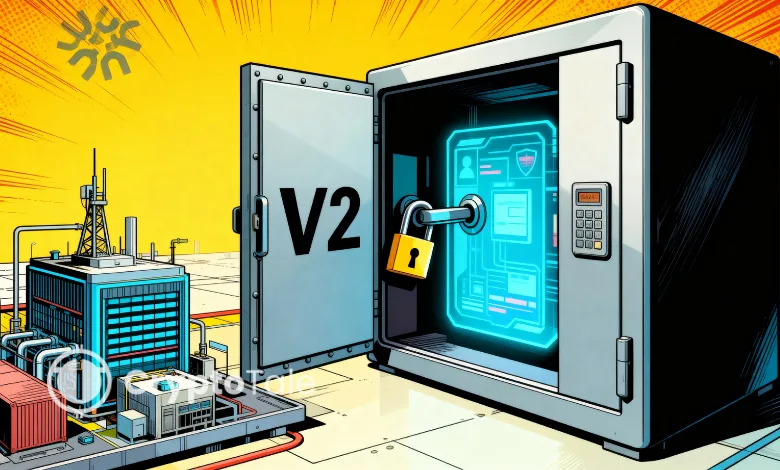
- USPD sets out a strong plan to guide holders through a structured recovery path.
- The team prepares a fresh V2 design that will reshape core parts of the protocol.
- New claim tokens will give users a clear tool for future redemption in the process.
USPD outlined a detailed recovery roadmap after the December 4, 2025, CPIMP exploit that allowed an attacker to mint 98 million USPD tokens and drain stETH collateral valued at $1 million. USPD presented a four-phase rollout plan beginning in late 2025. It includes claim token distribution, finalization of V2 architecture, an external audit, and protocol launch in early 2026. Compensation distributions will continue after the launch period.
Inside the CPIMP Attack: What’s the Context?
The team explained that the breach originated during proxy initialization on September 16. An attacker front-ran the deployment process and installed a shadow proxy implementation. This hidden layer forwarded calls directly to the audited contract, which made the system appear legitimate to both auditors and external observers.
The hacker maintained control of the system for many months. During that time, the hack imitated the legit contract actions and stayed unnoticed. This resulted in the unauthorized minting of USPD tokens that amounted to 98 million.
Moreover, around 232–237 stETH smoothed their way out of the protocol during the hack. As a result, liquidity dried up very fast, and user trust was also affected negatively. USPD announced that V1 has been decommissioned.
The company has stated that its recovery plan consists of user reimbursement and a total reconstruction of the system via USPD V2. They have further elaborated that this transition aims to regain confidence and establish a more robust system base.
Compensation Framework and Claim Tokens
USPD introduced its claim token compensation model. Each affected user will receive tokens at a 1:1 ratio based on snapshots recorded immediately before the exploit. The team said these tokens will act as redemption tools for the recovery process.
In addition, they confirmed the establishment of a dedicated recovery pool funded entirely through protocol revenue. This pool will remain isolated from the community treasury. Its only purpose is to compensate impacted holders. This structured approach was designed to ensure that compensation remains the first financial priority for the protocol.
The team added that the community treasury will support development and other initiatives only after recovery obligations are fulfilled. They also announced a gated Telegram group for affected users, enabling direct updates and structured feedback throughout the V2 rollout.
USPD V2 Architecture and Technical Changes
USPD V1 introduced a native yield that automatically increased user balances. While this feature improved wallet experience, it created friction across DeFi platforms that rely on controlled ledger updates.
Platforms like Aave and Uniswap use internal accounting systems. These systems malfunction when balances are adjusted without transfer events. The team said they had been developing a wrapped version of USPD to address issues. Yet they now plan to embed
Related: USDH Proposal V2 Brings $20M Incentives and PayPal Global Access
DeFi compatibility is at the core of V2. They outlined improvements, including integrated yield tiers, a unified token model, and a simplified technical structure. These changes address challenges from V1, including contract size constraints, circular dependencies, and complex deployment steps.
USPD also reported that privacy considerations are part of the redesign. Railgun integration is under evaluation. The team aims to introduce default privacy protections while maintaining operational clarity.
Additionally, USPD described new steps toward greater transparency for stabilizer operations. They noted that collateral always remained fully on-chain and overcollateralized. Stabilizers previously opened short positions on centralized exchanges to hedge risk. The team is now reviewing decentralized perpetual markets to create on-chain hedging options. This would give users clearer visibility into hedging behavior and reduce reliance on centralized platforms.