Brazil Backs Live Orchestra Turning Bitcoin Data Into Music

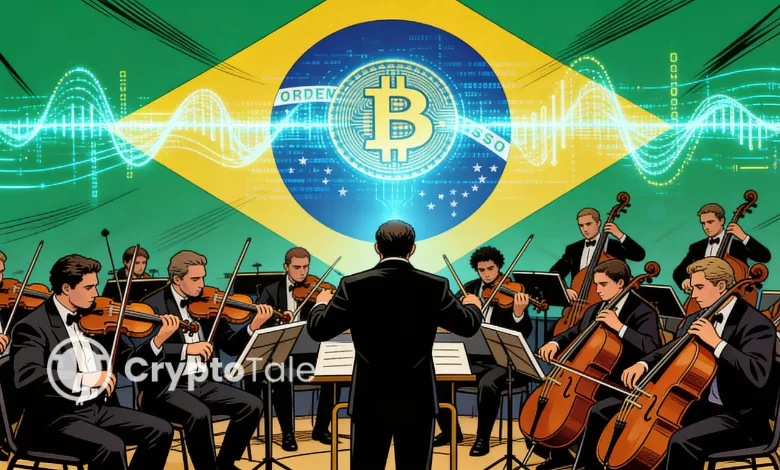
- Brazil approved a live orchestra project converting Bitcoin price movements into music.
- Funding up to 1.09 million reais was approved under Brazil’s Rouanet cultural incentive law.
- An algorithm will translate real-time Bitcoin market data into orchestral compositions.
Brazil has approved a live orchestral project that will turn Bitcoin price movements into music during a public performance in Brasília. The initiative received authorization to raise up to 1.09 million reais, equal to about $197,000, through Brazil’s cultural funding system.
The approval came under the Rouanet Law, which allows tax-deductible funding for eligible cultural programs across the country. As a result, private companies and individual donors can support the project and deduct contributions from their taxes.
Fundraising must close by December 31, according to details published in Brazil’s Federal Register. The concert will take place in Brasília, the nation’s federal capital and a central hub for government-backed cultural events.
Bitcoin Data Drives Live Musical Composition
An algorithm will monitor changes in the price of Bitcoin and technical indicators in real time throughout the performance. When the orchestra plays live on stage, these data points will direct melody, rhythm, and harmony. The music will change in response to changes in Bitcoin prices, using sound to represent market volatility.
The project blends conventional orchestral instruments with automated data-driven composition systems. Organizers describe the concept as an intersection of art, mathematics, economics, and physics. The goal is to translate abstract financial behavior into an audible form that audiences can experience directly.
The Federal Register confirmed that the initiative met all technical requirements under Brazil’s cultural incentive framework. The project falls under the Instrumental Music category, which defines how tax incentives apply to sponsors. However, the official publication did not state whether blockchain or on-chain infrastructure would support the performance.
Sources familiar with the project said the focus remains on real-time price data rather than blockchain execution. They added that the system converts numerical data into musical notation using predefined algorithmic rules.
Brazil Expands Crypto Themes in Cultural Projects
Brazil’s approval highlights a different approach to crypto-related initiatives within public cultural programs. Instead of focusing on trading or regulation, the project uses Bitcoin as a creative data source.
Similar experiments have appeared globally in algorithmic and data-driven art. In 2020, artist Matt Kane released “Right Place & Right Time” through Async Art. That programmable NFT used Bitcoin market data to drive continuous visual changes in the artwork. Elsewhere, artist Refik Anadol has built immersive installations using artificial intelligence and large datasets.
In July 2023, Anadol launched “Winds of Yawanawá,” an NFT collection created with the Yawanawá Indigenous community. That project combined environmental data with traditional artistic expression from the Brazilian Amazon. The new orchestral performance follows a comparable logic by merging financial data with creative output.
Related: Brazil Exchange B3 Plans Tokenization Platform, Stablecoin
Still, officials emphasized that the concert operates strictly under cultural funding rules. The authorization does not classify the project as a crypto or blockchain initiative. Instead, it treats Bitcoin price data as a raw material for musical interpretation.
Organizers said they will rely on publicly available market feeds during the performance. They also confirmed that the orchestra will perform live rather than using pre-recorded compositions.
The project description noted that the algorithm responds continuously throughout the concert. As a result, no two performances would produce identical musical results. The concert adds to a growing list of experiments that explore how digital markets intersect with art.