
Supreme Court to Rule on Legality of Trump Global Tariffs US

- Supreme Court set to rule on the legality of Trump tariffs imposed under emergency trade powers.
- Trump warns adverse ruling could force massive repayments and disrupt investment flows.
- Markets await decision as prediction data shows low odds Supreme Court upholds tariffs.
The US Supreme Court is set to rule on President Donald Trump’s global tariffs, putting his trade policy under intense legal scrutiny. The court scheduled January 14 as an opinion day. That timing signals a possible decision on the tariffs’ legality.
Trump first imposed the tariffs in April 2025. He applied them to imports from most global economies. Now, businesses, investors, and governments await the outcome. Markets worldwide remain on edge ahead of the ruling.
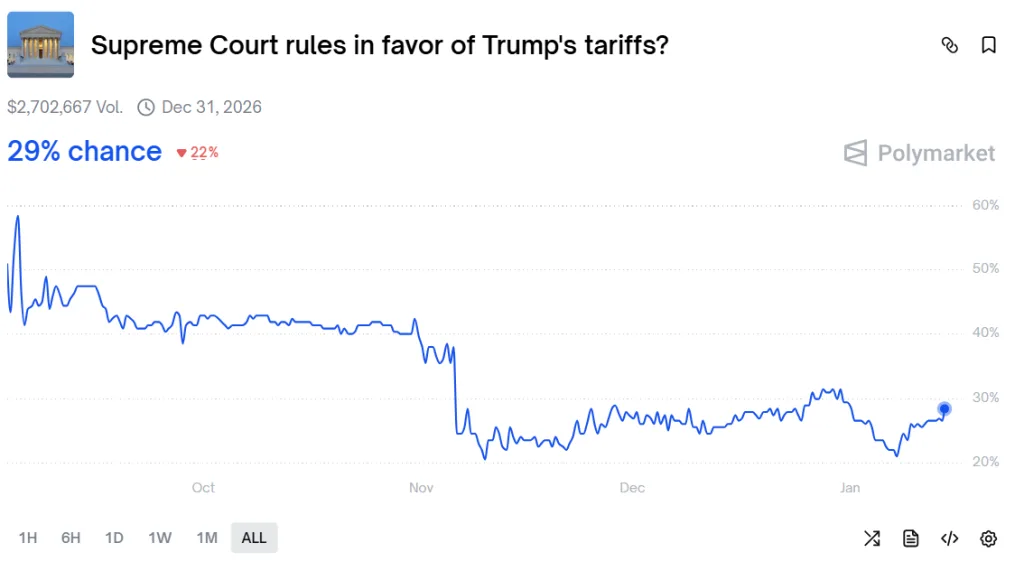
Prediction markets also reflect uncertainty. Polymarket data shows just a 28% chance that the court upholds the tariffs.
Source: Polymarket
Trump has warned that an adverse ruling would cause severe economic disruption. On January 12, Trump posted on Truth Social. He described an unfavorable decision as catastrophic for the country. Trump said the United States would owe massive repayments. He claimed refunds could reach hundreds of billions of dollars.
He also referenced private investments linked to the tariffs. Trump argued those figures push total exposure into trillions. According to Trump, such costs would overwhelm the nation. He said repayment would prove nearly impossible.
Supreme Court Review Puts Tariff Authority in Question
The Supreme Court heard oral arguments on the case in November. Several justices expressed doubts during that session. At issue lies Trump’s use of emergency powers. He relied on the 1977 International Emergency Economic Powers Act.
Trump declared a national emergency tied to the US trade deficit. He cited national security as justification. Critics challenged that interpretation. They argued the law does not support broad tariff authority.
Lower courts have already weighed in. A federal appeals court ruled in August that most tariffs were unlawful. That ruling followed a lawsuit from US businesses. The firms said the tariffs harmed operations and raised costs.
The Supreme Court now holds final authority. Its decision could affirm or overturn earlier judgments. If the court strikes down the tariffs, legal consequences could follow. Companies may seek refunds for past payments.
The federal government collected about $200 billion more in tariff revenue during 2025, paid by importing firms.
Trump disputes the narrow focus on tariff revenue. He emphasized investment decisions tied to trade barriers. He argued companies built US factories to avoid tariffs. He included those expenditures in his warning.
However, Trump did not provide a calculation method. He also did not cite official data supporting the trillions estimate. Some pledged investments remain incomplete. Several firms have delayed or scaled back announced projects.
Related: Trump-Backed World Liberty Expands Stablecoin Lending Market
Markets Brace for Global Impact
The Supreme Court session takes place on Wednesday morning Eastern Time. Traders expect volatility regardless of the outcome. A ruling in Trump’s favor could preserve the tariff framework. That outcome would maintain current trade costs. A ruling against him could force policy changes. It may also trigger new trade negotiations.
Foreign governments continue monitoring developments. Many economies face tariffs under the existing regime. Businesses have also adjusted supply chains. Some shifted sourcing to reduce exposure. Others absorbed higher costs.
Legal experts note the broader implications. The ruling could redefine executive authority over trade. It could also shape future emergency power claims. Congress may face pressure to clarify the law.
Trump framed the case as a national security issue. He warned of chaos if the court intervenes. He said financial responsibility would stretch across years. He questioned whether repayment would even be possible.
For now, uncertainty dominates. Firms worldwide await clarity from the court. The decision could reshape US trade policy. It may also influence global economic stability in the months ahead.