
Bitcoin Tops $72K as Futures Interest Builds Marketwide


- Bitcoin rose above $72K as volume and deeper liquidity sustained the latest move.
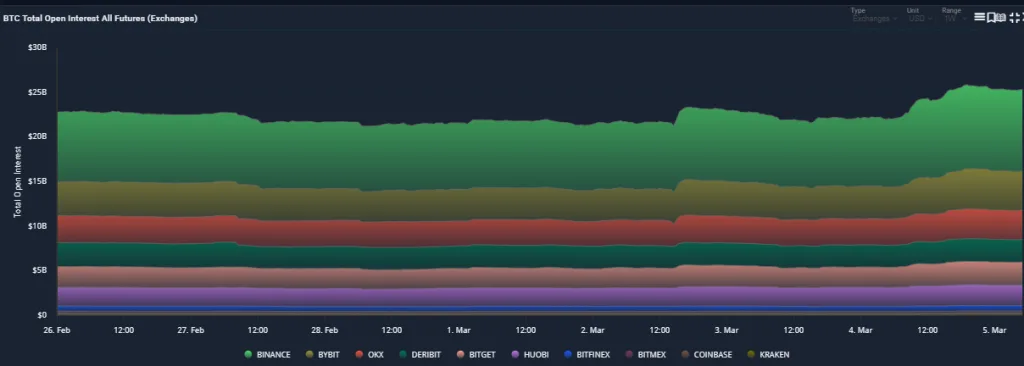
- Futures open interest climbed toward $26B as leverage expanded across major exchanges.
- Glassnode and hashprice data showed supply stress and a mining sector under strain.
Despite the market falling, Bitcoin appears to be the current glimmer of hope for investors. The token is trading at $72,576, up 6.91% in 24 hours, according to CoinMarketCap. The asset opened the session near $67,770 and then moved steadily above $72,000. It later held near $72,570 as trading activity kept strong.
The move lifted Bitcoin’s market capitalization to $1.45 trillion. Over the same period, 24-hour trading volume rose to $73.67 billion, a 45.6% increase from the prior session. The volume-to-market-cap ratio reached 5.12%, showing firm market liquidity during the rally.
At the same time, derivatives data showed rising participation across futures markets. That shift came as on-chain data also pointed to pressure from loss-held supply and tighter mining economics.
Futures Positioning Builds Across Major Exchanges
Data from Laevitas shows that Bitcoin’s total open interest across all futures exchanges stayed elevated from February 26 to March 5. The combined figure moved mostly within a range of $21 billion to $26 billion. Around February 26, total open interest stood near $23 billion. It then eased toward $21 billion to $22 billion by February 28, showing a modest pullback in derivatives exposure.
By March 1 and March 2, open interest held close to $22 billion. That stable range pointed to balanced positioning before traders added exposure again in early March. From about March 3, the metric moved back above $23 billion. It kept rising through March 4 and March 5, when total futures exposure approached $25 billion to $26 billion, one of the strongest levels on the chart.
Source: Laevitas
Binance held the largest share of open interest throughout the period. Bybit ranked second, while OKX and Deribit also carried large portions of market exposure. Other platforms, including Bitget, Huobi, Bitfinex, BitMEX, Coinbase, and Kraken, held smaller but steady shares. The spread across exchanges showed that the increase in open interest came from broad market activity, not from one venue alone.
Loss-Held Supply Adds Another Layer of Pressure
Glassnode data shows that 43% of the Bitcoin supply is now held at a loss, based on the last moved price of each coin. That figure rose from 30% when Bitcoin traded near $90,000 in late January. This change has raised concern among traders. Some market participants fear that holders now sitting at a loss may sell into strength as prices recover.
That possibility could create overhead supply during any further advance. Will those holders sell into recovery, or wait for higher levels?
Related: Paraguay Turns Seized Miners Into a State Bitcoin Drive
Mining Economics Remain Under Strain
The mining sector also faces pressure from rising costs and changing demand. Growing demand for artificial intelligence computing has increased competition for power and infrastructure.
At the same time, higher energy costs and weaker demand for the Bitcoin blockchain registry have pushed miner profitability toward low levels. Several listed mining companies have shifted part of their focus toward AI computing and sold Bitcoin holdings in the process.
Data from the Hashrate Index Bitcoin Hashprice Index tracked miner revenue in USD per petahash per second over one day. The chart showed hashprice near $29.8 on March 4 at 08:00. It later climbed above $32.2 before easing back. By March 5 at 08:00, the metric stood near $31.9, showing that mining returns improved during the day before stabilizing.