
Crypto Firms Expand AI Across Trading and Research Tools


- Cryptocurrency firms now deploy AI in research, trading, security, and payment systems.
- Exchanges add agent layers so users can automate strategies without writing code.
- Security firms use AI to expand audit coverage and monitor projects in real time.
Cryptocurrency companies are moving deeper into AI across research, trading, security, and payments, according to Tiger Research. The report says firms are no longer treating AI as a side theme. Instead, they are applying it to services that users can access directly. The shift reflects a practical need. Crypto research data remains scattered across platforms, and verification often takes time. Because of that, general AI tools have struggled to return reliable answers in crypto-related queries.
Tiger Research says specialized services are now trying to solve that problem. Projects such as Surf focus on crypto-specific research and offer users a more convenient way to work with market data. As a result, research has become one of the first areas where AI has gained broad traction in the crypto market.
Research and Trading Draw Early Adoption
Research tools have spread quickly because they require little technical skill. Users do not need to code or trade actively to use them. That lower barrier has made research one of the easiest entry points for AI in crypto.
Exchanges, meanwhile, are deploying AI to support trading activity. The report says some platforms give users access to trading data through AI tools. Others let users issue natural-language commands that cover both analysis and trade execution.
That marks a change from the earlier API model. Exchanges had long offered APIs, but they mainly served developers. Now they are adding layers such as MCP and AI skills so users can access functions through AI agents without writing code.
Tiger Research says more non-developers are already using AI agents to set up automated trading strategies. Users can describe a strategy in plain language, and the system can turn it into an executable workflow. For exchanges, that creates both an opening and a risk, since connected agents may reduce loyalty to any single platform.
Security Firms Expand Coverage With Automation
The report also points to security as a major area of AI adoption. Smart contract audits once depended on manual code review, which was expensive, slow, and limited by human oversight.
Now, firms are using AI to scan codes before auditors complete deeper reviews. Tiger Research says the model improves speed and coverage while keeping humans in the loop. The goal is not to replace auditors but to make their work more efficient.
CertiK stands out in that shift. After a project it audited experienced a hack, the firm faced criticism. Tiger Research notes that the incident fell outside the audit scope because audits examine codes at a specific moment rather than provide ongoing monitoring.
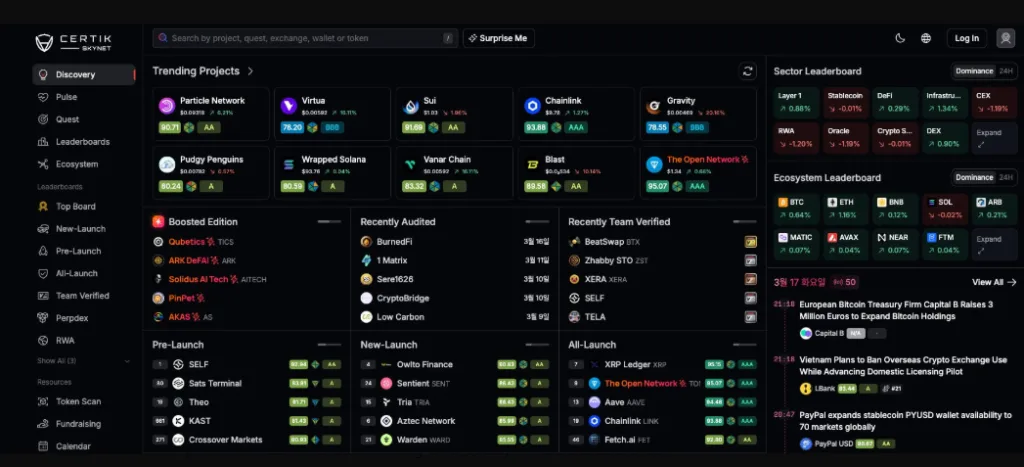
To address that gap, CertiK added AI-based monitoring tools that track projects after audits. Those tools feed into dashboards that allow real-time observation. In that structure, AI extends coverage beyond the original audit window.
Payments Emerge as the Next Front
Tiger Research says payment infrastructure may become another important AI-linked segment. AI agents need ways to pay for APIs, datasets, and other services. In crypto, the most natural options are on-chain wallets and stablecoins.
Two models are now emerging. One embeds payments into HTTP requests so an on-chain transaction occurs as soon as an agent connects to a paid API. The other uses agent-specific payment plugins with limits and permissions set by humans.
The circle has drawn attention in that area. The report says the USDC issuer proposed linking its Gateway payment infrastructure with the x402 protocol and invited developers and researchers to review the idea. The market remains early, but Tiger Research says the narrative has already influenced pricing around Circle.
Related: American Fintech Council Backs Fed Payment Account Opening Access for Crypto Firms
The report places this broader shift in a larger timeline. When ChatGPT launched in November 2022, neither AI nor crypto was ready for real integration. AI tools were still early, while crypto faced a trust shock after the FTX collapse.
That picture has changed. Tiger Research says AI infrastructure such as MCP and OpenClaw has made agent-based systems more practical. At the same time, larger crypto firms, including Coinbase, Binance, and Bitget, have started moving directly into the sector.
The report says these companies are not acting for marketing alone. They are responding to competitive pressure and the risk of falling behind as AI tools become more usable. Even so, Tiger Research notes that real-world adoption still faces limits, especially when users must trust agents with money or depend on payment systems that are still developing.