FBI New York Flags Suspicious FBI-Themed Token on Tron, Warns Public Not to Engage


- FBI New York warned Tron users after a fake FBI token pushed phishing links and AML claims
- At least 728 wallets held the token, with some containing more than $1 million in USDT
- Low Tron fees helped scammers spread the token fast while targeting users for personal data
A scam token distributed on the Tron blockchain has triggered a public warning after it appeared to impersonate the US Federal Bureau of Investigation and direct wallet holders to a phishing site designed to collect personal information. In a post published by the FBI New York on Thursday, the agency urged users not to interact with any token claiming to be linked to the bureau and warned recipients not to submit identifying details to related websites.
The fraudulent token reportedly arrived in wallets with a message stating that the holder’s assets were “under investigation” and that an online anti-money laundering verification was required to avoid a complete freeze. The wording followed a familiar scam pattern in crypto: create urgency, invoke enforcement, and pressure users into disclosing sensitive data.
The bureau said anyone who already provided information through the site should file a complaint with the Internet Crime Complaint Center, the central reporting platform for cyber-enabled crime in the United States.
Fake FBI Branding Turned Into a Phishing Weapon
The warning gained attention as the token used the bureau’s name and seal while presenting itself as an enforcement notice. A screenshot shared through FBI New York appeared to show the scam operating through the TRC-20 token standard on Tron, where recipients were told they faced asset restrictions tied to alleged AML violations unless they completed a verification process online.

That approach mirrored the structure of many phishing operations in the digital asset sector, where attackers rely on fear and institutional branding to push victims into fast decisions. The bureau did not state how many users were affected, but the message made clear that the token and its linked website were not legitimate.
Tron’s Cheap Transfers Supercharged the Scam’s Reach
Per reports, the operation appears to have taken advantage of Tron’s low transaction costs and speed, two features that make the network attractive for both legitimate stablecoin transfers and mass spam campaigns. The tokens were created about eight days before the public warning, and at least 728 wallets were reportedly holding them when the alert was issued.
Several of those wallets were said to contain more than $1 million in USDT. The data also pointed to industrial-scale distribution. One address reportedly sent about 920 transactions using roughly 120 TRX, equivalent to around $40, while another address carried out about 4,800 account-creation transactions.
That activity suggested a setup designed to generate and deploy spoofed addresses quickly. TRM Labs has previously documented how bots can monitor active wallets and send dust transactions within seconds, making Tron particularly effective for this type of broad phishing delivery.
Scam Losses Deepen Across Crypto Markets
The warning lands against a wider backdrop of rising crypto-related fraud. In April, the FBI said it received more than 140,000 complaints referencing crypto scams in 2024, with reported losses reaching $9.3 billion, up 66% from the previous year.
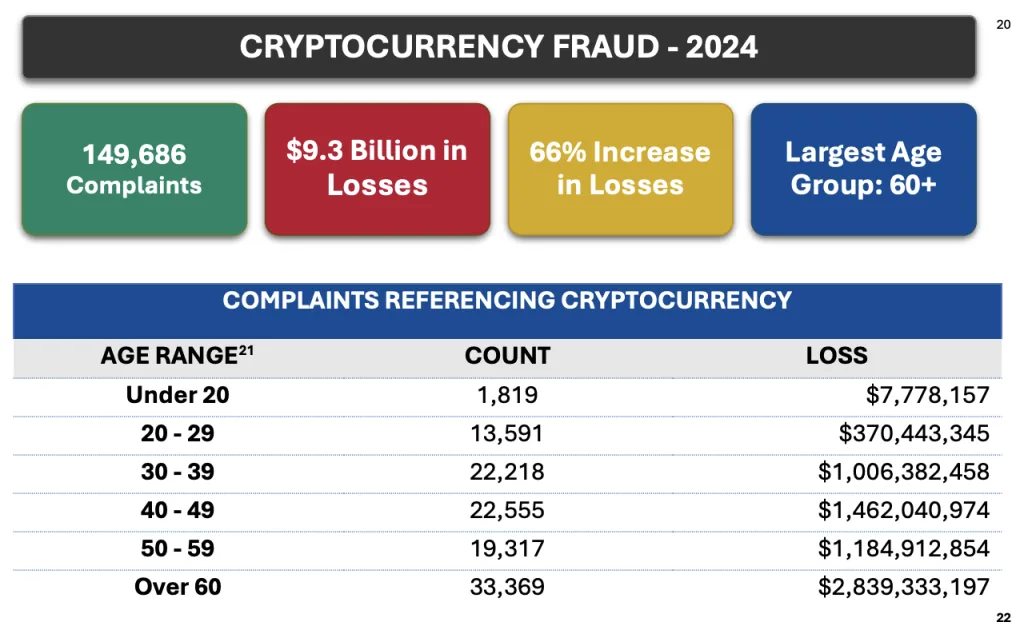
In a separate 2024 report, the bureau said crypto fraud losses had climbed by 45% compared with 2022 and highlighted the growing role of pig-butchering schemes that combine romance tactics with fake investment offers. Other agencies have reported similar pressure points.
The Federal Trade Commission has previously said romance scam losses topped $1 billion in a single year, while Chainalysis estimated total crypto scam and fraud losses reached $17 billion in 2025, up from $12 billion in 2024. According to that estimate, impersonation scams rose 1,400% year over year, while AI-assisted scams were 4.5 times more profitable than traditional methods.
Related: Prediction Platform Polymarket Acquires Brahma to Deepen DeFi Infrastructure Push
Past Operations Turned Tokens Into Bait
The latest warning also stands in contrast to a separate crypto-related operation carried out by the bureau in 2024. In that case, the agency launched a fake AI-themed token called NexFundAI as part of a sting targeting market manipulation. That operation led to charges against at least 18 individuals accused of helping inflate trading activity through pump-and-dump tactics.
In the Tron case, however, the message from the agency was straightforward: the token was fraudulent, the website linked to it was not to be trusted, and users were advised to avoid engagement and report any exposure through official channels.