
Fidelity Urges SEC to Clarify Crypto Broker-Dealer Rules


- Fidelity urged clearer SEC rules for crypto custody and broker-dealer activity now.
- Fidelity wants firm ATS standards for tokenized securities market trading this year.
- It also seeks guidance on blockchain records and upcoming on-chain settlement roles.
Fidelity Investments has urged the U.S. Securities and Exchange Commission to move faster on crypto regulation, with a focus on broker-dealers and alternative trading systems. The firm said clearer rules would help integrate digital assets into existing market structures while protecting investors and preserving market integrity. The request came in a letter submitted Friday to the SEC Crypto Task Force.
Fidelity said it supports the agency’s effort to adapt older market rules to new technology, but it also warned that firms still need clearer direction on custody, trading, and tokenized assets.
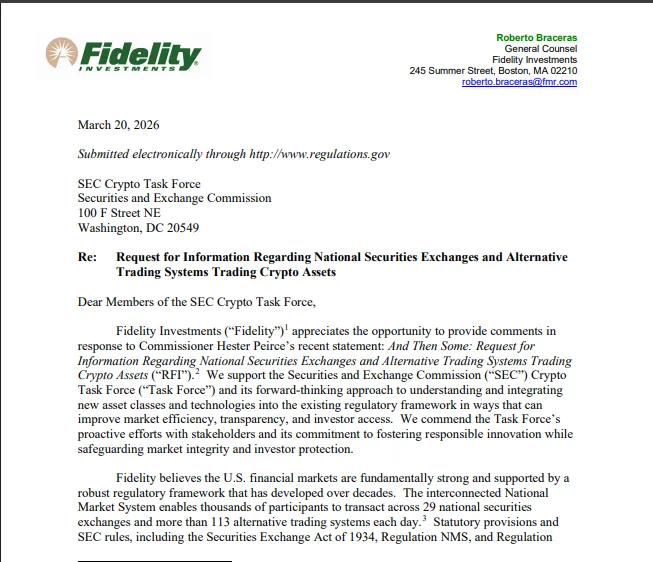
The letter answered Commissioner Hester Peirce’s December request for input on how national securities exchanges and ATS platforms should handle crypto asset trading. Fidelity used the response to outline four recommendations for the agency as digital asset markets continue to develop.
Fidelity Seeks More Guidance for Broker-Dealers
Fidelity’s first recommendation focused on broker-dealers that offer services tied to crypto assets. The firm pointed to recent SEC guidance allowing broker-dealers to custody both crypto asset securities and non-security digital assets, describing that step as welcome but incomplete.
Fidelity said firms still need more direction before they can confidently offer custody, trading, and crypto-security trading pairs within a regulated framework. It argued that the current rules leave too much uncertainty for firms trying to operate in both traditional and digital markets.
“[We] look forward to additional guidance on a number of other areas critical for broker-dealers to offer, custody, and trade crypto assets and facilitate crypto-security trading pairs,” Fidelity said in the letter.
Recent SEC actions have moved in that direction. In the last few months, the agency has issued guidance on broker-dealer custody and tokenized securities. Those moves suggest a gradual shift toward accommodating blockchain-based financial infrastructure.
At the same time, Peirce has encouraged firms working on tokenization to engage regulators directly. That approach marks a more open tone than earlier periods that relied more heavily on enforcement.
ATS Rules and Tokenized Securities Remain a Key Issue
Fidelity also argued that the SEC should create clearer standards for alternative trading systems that want to support tokenized securities in secondary markets. The firm said current rules do not fit well with decentralized platforms and need meaningful revision.
It called for bright-line standards that would allow ATS platforms to facilitate trading in tokenized securities issued by third parties. Without that clarity, broker-dealers may face legal risk when trying to determine how a tokenized instrument should be treated.
“The SEC should provide bright-line standards that permit ATSs to facilitate secondary market trading in tokenized securities created by third parties,” Fidelity said. “This clarity is critical because the regulatory status of a tokenized instrument depends on its economic realities, key facts that may not be fully known to a broker-dealer.”
Fidelity also said tokenized versions of traditional securities should generally carry the same regulatory treatment as the underlying assets. In its view, that would reduce fragmentation between on-chain markets and conventional financial systems.
Related: Fidelity to Debut GENIUS-Compliant Stablecoin FIDD on Ethereum
Blockchain Settlement and Market Structure Questions Persist
Fidelity then turned to the broader question of how traditional intermediaries and decentralized trading venues can operate alongside one another. Blockchain-based systems may offer faster settlement, lower costs, and more transparency, the firm said, but they may not provide the same safeguards required of regulated intermediaries.
For that reason, Fidelity urged the SEC to clarify how firms can use distributed ledger technology without taking on unintended regulatory burdens. It specifically asked the agency to confirm that broker-dealers using blockchain for recordkeeping or facilitating on-chain settlement would not automatically become clearing agencies.
Those issues gained more attention after a joint SEC and CFTC interpretation issued on March 17, 2026. That interpretation grouped crypto assets into five categories: digital commodities, digital collectibles, digital tools, stablecoins, and digital securities.
The framework aims to clarify when transactions involving those assets may fall under federal securities laws. Still, Fidelity’s letter suggests that market participants want more detailed rules before crypto trading can fit smoothly into the existing U.S. market structure.