
NYSE Lifts Limits on Bitcoin and Ether ETF Option Trades


- NYSE Arca and NYSE American scrapped caps on options tied to 11 crypto ETFs today.
- The SEC waived its waiting period, allowing the rule changes to take effect at once.
- The shift expands FLEX trading and gives institutions broader hedging capacity now.
Two New York Stock Exchange-affiliated exchanges have removed position limits on options tied to 11 Bitcoin and Ether exchange-traded funds, following fast-tracked approval from the U.S. Securities and Exchange Commission. NYSE Arca and NYSE American filed rule changes on March 10 to eliminate the 25,000 contract cap. Soon after, the SEC acknowledged the filings and waived the usual 30-day delay.
As a result, the changes took immediate effect. The move ends restrictions first introduced in November 2024, when crypto ETF options began trading under tighter oversight. At the same time, the shift aligns crypto ETF options with broader commodity ETF standards, which rely on dynamic position limits based on liquidity and size.
SEC Approval Accelerates Market Shift
The SEC confirmed that the proposals raised no new regulatory concerns. It pointed to similar approvals already granted to rival exchanges across the U.S. options market. Earlier this year, Nasdaq ISE and Nasdaq PHLX submitted comparable filings in January. Soon after, MIAX followed, while MEMX filed in February and Cboe in March.
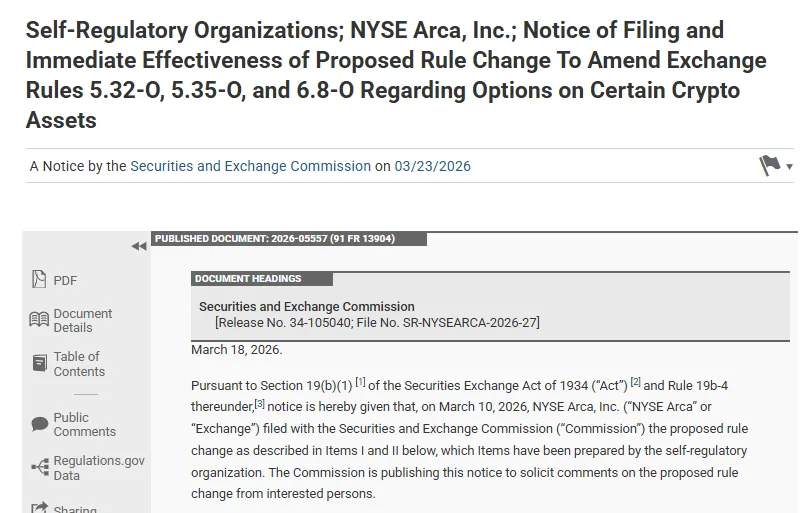
Now, with NYSE Arca and NYSE American joining, every major U.S. options exchange has completed the transition away from fixed contract limits. Meanwhile, the SEC continues to review a separate Nasdaq ISE proposal. That filing seeks to raise position limits for BlackRock’s iShares Bitcoin Trust options to 1 million contracts.
The comment period for the NYSE filings remains open until April 13, allowing market participants to provide feedback on the rule changes.
Expanded Flexibility for Institutional Trading
Previously, exchanges imposed position limits to curb volatility and reduce the risk of market manipulation. These controls reflected early caution as crypto-linked derivatives entered regulated markets. Now, position limits will follow standard exchange frameworks. These frameworks base limits on trading volume and shares outstanding, allowing larger caps for highly liquid funds.
For instance, options tied to large ETFs may qualify for limits of 250,000 contracts or more under existing rules. The removal of restrictions also allows these products to trade as FLEX options. These contracts enable customized strike prices, expiration dates, and exercise styles.
As a result, institutions can structure more precise hedging strategies and tailored financial products. This flexibility supports complex trading approaches such as basis trades and portfolio overlays.
The rule changes cover options linked to several major crypto ETFs. These include BlackRock’s iShares Bitcoin Trust (IBIT), Fidelity’s Wise Origin Bitcoin Fund (FBTC), and ARK 21Shares Bitcoin ETF (ARKB). They also include products from Grayscale and Bitwise that track both Bitcoin and Ethereum.
Related: NYSE Tokenization Strategy Sparks Debate Over Missing Details
Broader Market Implications for Crypto Derivatives
The policy shift treats Bitcoin and Ether ETF options the same way as traditional commodity ETFs, which include SPDR Gold Trust and iShares Silver Trust. The existing regulatory framework now treats cryptocurrency derivatives in the same way as it does traditional asset classes. This alignment may improve liquidity. It could also ease entry and exit for traders by reducing structural barriers tied to position caps.
The unified market operations between different exchanges demonstrate the industry’s increasing tendency to create unified systems. Crypto derivatives now sit more firmly within mainstream financial infrastructure. The change also signals growing regulatory confidence in the stability of crypto ETF markets, which have developed since their initial launch.
The remaining question involves whether increased position limits will lead to higher institutional involvement in crypto derivatives markets. The removal of fixed caps establishes a new operational system for exchanges, which now implement adaptable systems that grow according to market conditions and user activity.