
Circle Shares Sink as Stablecoin Bill Risks Deepen in U.S.


- Circle lost 20.11% as investors weighed new limits on stablecoin yield offerings.
- The proposed Clarity Act language could reshape how USDC platforms reward users.
- A late compromise kept the bill alive while banks and crypto firms reviewed terms.
Circle Internet Financial shares fell sharply on Tuesday as investors reacted to reports that a possible compromise in a U.S. crypto market structure bill could ban rewards on stablecoin balances. Google Finance data showed the stock down 20.11% to $101.17 at press time, a loss of $25.47 on the day. The stock traded between $127.08 and $98.31 and stayed well below its previous close of $126.64. After-hours trading showed only a slight rebound to $101.22. The move came as concerns grew around how new rules could affect USDC, Circle’s core stablecoin business.
Sharp Sell-Off Follows Early Bill Concern
The chart showed heavy selling soon after the opening bell. Shares then moved sideways for much of the session, with only a brief afternoon recovery. Even so, the stock did not retake the $105 level. That left Circle deep in the red by late trading.
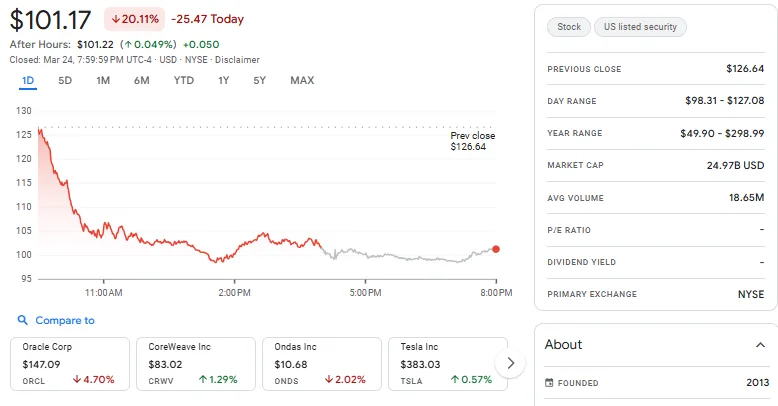
Google Finance also showed Circle’s market capitalization at $24.97 billion. Average volume stood at 18.65 million shares, pointing to strong trading activity during the drop. At the center of the sell-off was a reported provision tied to the Clarity Act. Barron’s said the measure would ban platforms from offering yield on stablecoin balances in ways that resemble bank deposits.
A report by Barron’s said the proposal appeared in an email sent by the Blockchain Association to its members. The report added that the proposal would still allow activity-based rewards, though the group wants more detail.
That distinction matters for Circle because it issues USDC, the second-largest stablecoin by circulation. Coinbase acts as USDC’s distribution partner, and the two companies split revenue generated from reserve assets.
USDC Model Faces New Scrutiny
Those reserves sit mainly in Treasury bonds and reverse repurchase agreements. That structure links Circle’s earnings to the scale and usage of USDC. Some trading platforms offer yield to encourage users to hold stablecoins on their services. Coinbase customers, for example, can earn a 3.5% yield on USDC holdings.
Banks have pushed back against that model. Trade groups say such products could pull deposits away from traditional institutions and reduce lending capacity.
For weeks, senators have tried to keep the Clarity Act alive. The broader bill aims to define how digital asset trading would be regulated in the United States. The crypto industry has pressed for that clarity for years. One reason is that the bill would exempt most crypto trading from securities laws.
Yet the stablecoin yield issue has created a new fault line between crypto firms and banks. Could that fight now reshape how stablecoin businesses grow in the U.S.?
Related: Circle CEO Says Stablecoins Can Power AI Payments Globally
Lawmakers Race Against the Political Clock
According to the text, the White House and Senators Angela Alsobrooks and Thom Tillis reached a compromise late last week. On Monday and Tuesday, they began reviewing the new draft with banks and crypto firms. Lawmakers also worry about timing. If the bill stalls much longer, Congress may not deliver it to President Donald Trump before midterm campaigning intensifies.
Recent polling, the text said, suggests Democrats have a strong chance of taking control of the House next year. That outcome could force more concessions on any delayed crypto bill.
That risk has raised the stakes for the industry. A longer delay could leave crypto firms exposed to tougher oversight later. At the Digital Asset Summit in New York on Tuesday, SEC Chairman Paul Atkins warned against that possibility. “We need to provide clarity, and Congress is the only one that can future-proof it,” Atkins said.
He also warned against a return to past regulatory hostility. Atkins said he “would really hate to see” a future regulator restore the adversarial approach of his predecessors.