
Nvidia Investor Class Action Tests Crypto Revenue Claims


- Nvidia faces a class action after investors challenged its crypto revenue disclosures.
- Plaintiffs say mining demand inflated gaming sales and masked deeper earnings risk.
- The ruling moves the case ahead as scrutiny of Nvidia’s 2018 statements now grows.
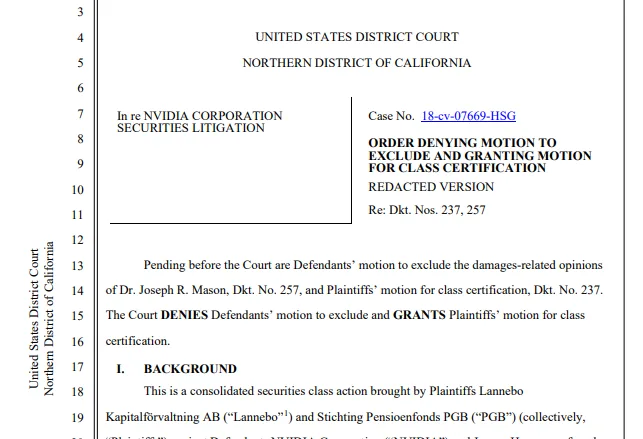
A federal judge in California certified a class of Nvidia investors on Wednesday. They claim the chipmaker and Chief Executive Jensen Huang hid how much gaming GPU revenue came from crypto mining in 2017 and 2018. Judge Haywood S. Gilliam Jr. said Nvidia failed to show its statements had no effect on the stock price, opening the way for investors to proceed together.
The order covers investors who bought Nvidia stock between Aug. 10, 2017, and Nov. 15, 2018. It moves the case closer to trial and puts renewed focus on the company’s crypto-era disclosures. How much of Nvidia’s gaming surge came from miners rather than gamers?
According to the order, plaintiffs say Nvidia steered investors toward the view that crypto-related sales were limited. They argue that a large share of mining demand actually ran through GeForce gaming GPUs, exposing the gaming segment to swings in the crypto market.
Dispute Turns on Segment Reporting
Plaintiffs say Nvidia told investors that crypto mining formed only a small slice of the business. They also say the company signaled that most mining demand sat in the OEM segment, not in gaming.
The lawsuit challenges that account. Plaintiffs argue a substantial share of mining demand flowed through GeForce gaming GPUs and that Nvidia recorded most of that revenue inside gaming. They say that distinction mattered because investors viewed gaming revenue as steadier, while crypto demand could reverse fast.
That revenue split sits at the center of the case. Plaintiffs say Nvidia’s public statements created the impression that the company had insulated its gaming business from crypto volatility, even as mining demand allegedly drove a meaningful share of sales.
Nvidia had maintained that crypto mining made up only a small part of its business. The company also said it controlled its supply chain and could clear excess graphics card inventory without trouble. In 2022, the SEC fined Nvidia $5.5 million over inadequate cryptomining disclosures, and the company settled without admitting or denying the findings.
The regulatory record adds weight to the investor claims. The SEC said Nvidia failed to disclose in two fiscal 2018 quarterly filings that cryptomining significantly fueled year-over-year growth in gaming revenue.
2018 Disclosures Shaped the Case
Plaintiffs point to 2018 disclosures as the moment when Nvidia’s exposure began to come into view. In August, the company cut guidance, acknowledged excess inventory, and said crypto demand had weakened, according to the order.
The order says plaintiffs treated the August and November 2018 statements as corrective disclosures. In their view, those comments revealed that post-crypto inventory and pricing pressure had reached the gaming business.
They say the issue became clearer on Nov. 15, 2018. On that day, Chief Financial Officer Colette Kress said gaming missed expectations because post-crypto inventory took longer to sell through. She also said gaming card prices took longer to normalize after a “sharp crypto falloff.”
Plaintiffs say those remarks marked the point when Nvidia’s exposure became clear to the market. They link the November disclosure to a 28.5% stock drop over the next two trading sessions. Gilliam wrote that the court could not conclude there was a price impact.
Related: YZi Labs Leads RoboForce’s $52M Round as NVIDIA Highlights Physical AI
He said internal evidence showed a Nvidia vice president viewed the stock as staying high after earlier comments. That finding helped the court dismiss Nvidia’s attempt to show that the alleged statements did not affect the share price.
The ruling lets investors pursue the case as one group rather than through separate suits. Gilliam also set a case management conference for April 21, 2026, to guide the next phase of the litigation.