Japan Tightens Crypto Cyber Rules as Microsoft Adds Billions


- Japan issued tougher crypto cyber rules as threats shifted far beyond key theft.
- The FSA will run live-style tests and tighten staffing and audit standards this year.
- Microsoft pledged $10B to expand Japan’s AI, cloud, cyber, and talent base by 2030.
Japan moved on two major technology fronts this week. The Financial Services Agency unveiled new cybersecurity guidelines for cryptocurrency exchanges, while Microsoft confirmed a $10 billion investment package for AI and cybersecurity in Japan. Both announcements focused on stronger defenses, local capacity, and long-term protection of critical digital systems.
The FSA released its “Cybersecurity Enhancement Guidelines for Cryptocurrency Exchange Businesses” on April 3. Microsoft disclosed its new package after a Friday meeting in Tokyo between company president and vice chairman Brad Smith and Prime Minister Sanae Takaichi.
As cyber threats grow more organized, can Japan’s financial and technology sectors strengthen defenses fast enough to protect assets, data, and critical services?
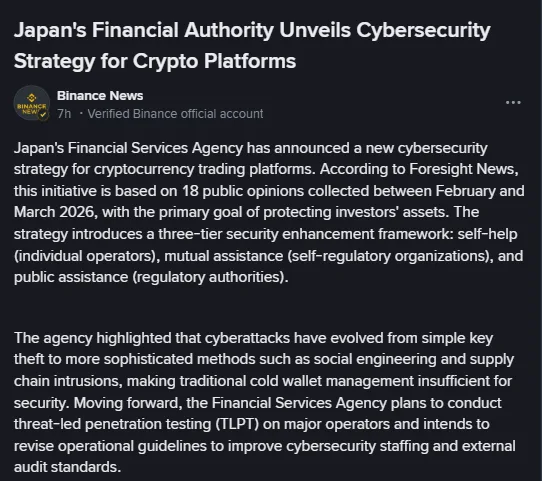
FSA Builds a Three-Layer Crypto Security Model
The FSA said it developed the new crypto guidelines after reviewing 18 public opinions collected between February and March 2026. The agency said its main objective is to protect investors’ assets more effectively, as attack methods keep changing.
The framework creates a three-tier model for stronger cybersecurity. It assigns responsibilities across self-help by operators, mutual assistance through self-regulatory bodies, and public assistance through regulators. The design aims to improve accountability, industry coordination, and supervisory oversight at the same time.
The agency said cyberattacks now extend beyond traditional private key theft. According to the guidance, attackers increasingly rely on social engineering and supply chain intrusions. The FSA said those methods require a broader defense system, because cold wallet management alone no longer offers enough protection.
The guidance also sets out direct next steps for major operators. The FSA plans to carry out threat-led penetration testing, or TLPT, to simulate real attack scenarios and test the security readiness of large platforms. The exercise will help identify vulnerabilities under conditions that mirror real-world threats.
Related: Japan Bond Yields Hit 25-Year High as Oil Crisis Deepens
At the same time, the agency plans to revise business guidance for crypto operators. It wants stronger cybersecurity staffing standards and tougher external audit requirements. Those changes would push platforms to improve both internal expertise and outside review.
Japan has also started including cryptocurrency-related scenarios in the Delta Wall cross-industry cybersecurity exercise. The move aims to improve emergency response across the wider financial sector. In parallel, the Japan Virtual Currency Exchange Association will encourage member firms to strengthen audit capabilities and improve information-sharing across the industry.
Microsoft Expands AI and Cybersecurity Push in Japan
Microsoft separately confirmed a new $10 billion funding package for Japan. The company said the investment will roll out over the next four years and adds to its earlier $2.9 billion commitment announced in April 2024.
A major part of the package centers on local infrastructure. Microsoft said it will work with Sakura Internet and SoftBank to develop cloud and AI systems in Japan. The two companies will provide GPU-based compute through Azure, while data processing remains inside Japan. Microsoft said this structure will support the development of Japan’s own large language models.
The investment package also extends beyond computing capacity. Microsoft said it will expand its collaboration with Japan’s National Police Agency to strengthen national cybersecurity. The company linked the project to its wider goal of building secure and reliable digital infrastructure in the country.
Workforce training forms another major piece of the plan. Microsoft said it will work with Fujitsu, Hitachi, NEC, NTT Data, and SoftBank to train one million AI engineers and developers in Japan by 2030. The company added that its earlier investments have already helped more than 3.4 million people develop AI skills.
Microsoft said more effort remains necessary because Japan could face a shortfall of 3.2 million AI and robotics workers by 2040. Brad Smith said the package reflects the company’s long-term commitment to the country. “We are bringing the world’s best technology, building secure and reliable infrastructure on Japan’s terms, and helping equip its workforce to accelerate productivity and innovation across its economy,” he said.