
Bitcoin Holds $71K as Oil Shock Hits Global Markets Today


- Bitcoin held above $71K as oil spiked and equity markets weakened worldwide again.
- Brent surged past $100 after Trump put Iran’s nuclear threat above oil price concerns.
- Steady institutional demand kept Bitcoin resilient as traders watched liquidity closely.
Bitcoin rose to its highest level in a week as Middle East tensions shook risk markets and drove oil above $100 a barrel. CoinMarketCap data showed Bitcoin at $71,369, up 1.25% on the week, with market value at $1.42 trillion and 24-hour volume at $46.02 billion. While stocks fell and oil surged, Bitcoin held firm and extended gains during the latest trading sessions.
Bitcoin Recovers After Early-Week Slide
Bitcoin dropped toward $66,000 earlier in the week before buyers stepped back in. It then climbed through March 10 and March 11 and reclaimed the $70,000 level. That rebound came with stronger trading activity. Data showed a 3.21% volume-to-market-cap ratio, pointing to active but orderly market participation.
Supply metrics stayed tight. Circulating supply stood near 20 million BTC, while Bitcoin’s maximum supply remained fixed at 21 million coins. Since the latest Middle East escalation on Feb. 28, Bitcoin has gained about 7%. Over the same stretch, the Nasdaq 100 stayed mostly flat, while the S&P 500 fell about 1%.
Gold also moved lower during that period. Silver fell harder, with a drop of nearly 9%, adding to the contrast with Bitcoin’s performance.
Oil Shock Hits Broader Markets
Traders kept a close watch on the Strait of Hormuz, a narrow route that handles roughly one-fifth of global oil shipments. Concerns over disruption lifted volatility across energy markets.
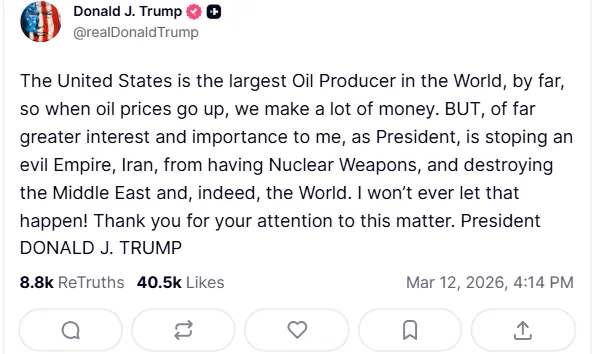
On Thursday, U.S. President Donald Trump said stopping Iran from acquiring nuclear weapons mattered more than oil prices. He made the remarks in a Truth Social post. “The United States is the largest oil producer in the world, by far, so when oil prices go up, we make a lot of money,” Trump wrote. “BUT, of far greater interest and importance to me, as President, is stopping an evil Empire, Iran, from having Nuclear Weapons.”
After those remarks, Brent crude futures jumped 9.2% and closed above $100 per barrel for the first time since Russia invaded Ukraine in 2022. It was also the benchmark’s biggest one-day gain since May 2020. Stocks moved the other way. Google Finance data showed the S&P 500 down 1.52%, the Dow down 1.56%, and the Nasdaq down 1.73% to 24,533.
Related: Metaplanet Launches New Units and Backs JPYC Stablecoin
Bitcoin Outperforms as Liquidity Stays in Focus
The divergence also showed during Wednesday’s U.S. session. BlackRock’s iShares Bitcoin Trust traded 1% higher while the S&P 500, Nasdaq 100, Russell 2000, and Dow all sat in the red. Market activity suggested continued demand from larger buyers. The text said institutions and big traders were buying coins through privately negotiated deals, helping support the market.
Nic Puckrin, co-founder of Coin Bureau and lead market analyst, said oil shocks have eventually led to Bitcoin weakness when liquidity tightens. “The deciding factor for Bitcoin usually ends up being global liquidity,” Puckrin said.
He said investors appeared to price in limited long-term damage to liquidity because they expected the oil crisis to be short-lived. Still, he warned that the picture could change if the crisis drags on.
“In 2022, the Bitcoin price drop was driven primarily by the Fed’s aggressive hiking cycle to curb inflation,” Puckrin added. “If the same scenario plays out and global liquidity tightens, Bitcoin’s current strength could be undermined.”
For now, Bitcoin has held up better than the broader market mood. The key question is whether that resilience can last if the conflict starts to reshape global liquidity.