Bitcoin Is Speculative Like Tulips, Says RBI Deputy Governor

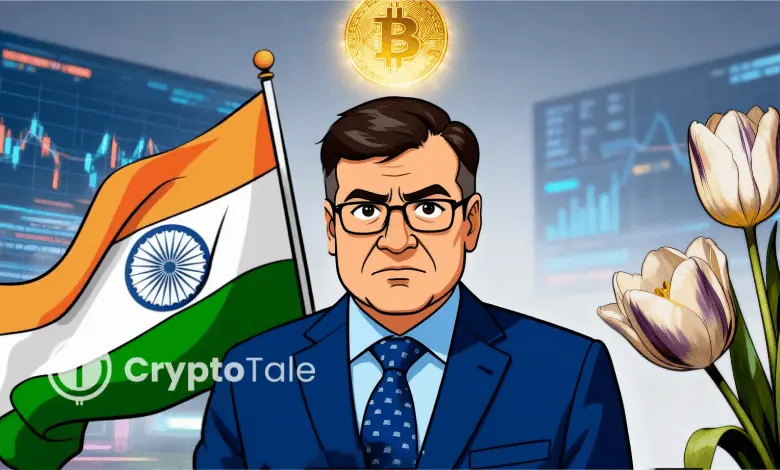
- RBI flags Bitcoin as lacking intrinsic value and unfit as money or a financial asset.
- Stablecoins are flagged as macroeconomic risks with no proven advantage over fiat currency.
- Crypto adoption in India expands rapidly despite volatility, taxes, and strict oversight.
Bitcoin drew renewed criticism from the Reserve Bank of India, with senior officials raising concerns about its economic relevance and financial stability. Despite these warnings, crypto adoption in India continues to expand at scale. Regulators remain concerned about speculation, volatility, and systemic risks.
At the Mint Annual BFSI Conclave 2025, RBI Deputy Governor T. Rabi Sankar stated that Bitcoin should not be viewed as money or a financial asset. He said Bitcoin lacks fundamental value. According to him, it does not meet the basic definition of currency used in modern economies.
The Deputy Governor said Bitcoin was never designed to represent value in the way money does. He added that its price is not supported by any economic foundation. According to him, the asset survives only on market belief.
To underline his point, Sankar compared Bitcoin to the 17th-century tulip mania. He said Bitcoin’s price exists because buyers are willing to pay for it. It is not backed by tangible assets or enforceable claims.
Blockchain Technology and Bitcoin’s Value Debate
Sankar explained that blockchain technology itself represents real innovation. He said Bitcoin was created mainly to demonstrate how blockchain works. The technology proved that digital tokens could be transferred between unknown parties without a trusted intermediary.
This breakthrough, he noted, unlocked several applications across finance and other industries. It enabled faster settlement and improved transparency. However, he stressed that these benefits do not justify Bitcoin’s market valuation.
Sankar also highlighted the absence of an issuing authority. He said Bitcoin carries no promise to pay. It generates no income and offers no ownership rights.
He argued that Bitcoin does not qualify as money. He also rejected its classification as a financial asset. According to him, assets must generate cash flows or represent productive capital.
Volatility was another major concern raised by the RBI official. Sankar noted that Bitcoin is trading nearly 30% below its historical peak. Many other cryptocurrencies have declined between 40% and 70%.
RBI Flags Stablecoin Risks as India Maintains Cautious Crypto Stance
The RBI’s caution extends beyond Bitcoin to Stablecoin markets. Sankar warned that stablecoins pose significant macroeconomic risks. He said they offer no advantage over sovereign fiat currencies.
Related: India Prepares ARC Token to Cut USD Stablecoins Reliance
Stablecoins gained global attention after the United States passed legislation to regulate dollar-pegged tokens. That move increased adoption and pushed global stablecoin market capitalization beyond $300 billion.
India has taken a different route from major economies such as Japan and the European Union. Policymakers fear that integrating crypto assets into the financial system could raise systemic risks.
Sankar said stablecoins could disrupt monetary stability. He cited risks to fiscal policy and banking intermediation. He also flagged concerns related to overall financial resilience.
According to Sankar, stablecoins do not serve any function that fiat money cannot. He said they remain inferior to sovereign currencies. Claims of efficiency gains, he added, remain unproven.
He argued strongly in favour of central bank digital currencies. Sankar said CBDCs are inherently superior to stablecoins. They offer state backing and regulatory certainty.
Despite repeated warnings, crypto adoption in India continues to rise. Industry estimates suggest the country has over 100 million crypto users. This places India among the largest global crypto markets.
Crypto exchanges report growing participation from smaller cities. Activity is no longer limited to major urban centres. Retail interest remains strong despite regulatory pressure.
The Indian government has maintained a restrictive stance. In 2022, it introduced a 30% tax on crypto gains and a 1% tax deducted at source on every transaction. Officials said these measures were intended to curb excessive speculation while improving traceability and oversight of crypto-related activity.
Adoption continues to expand across the market. Regulators remain firm in their view that Bitcoin and Stablecoin markets pose unresolved risks.