
Coinbase CEO Says Bitcoin Supports Dollar as Rules Ease

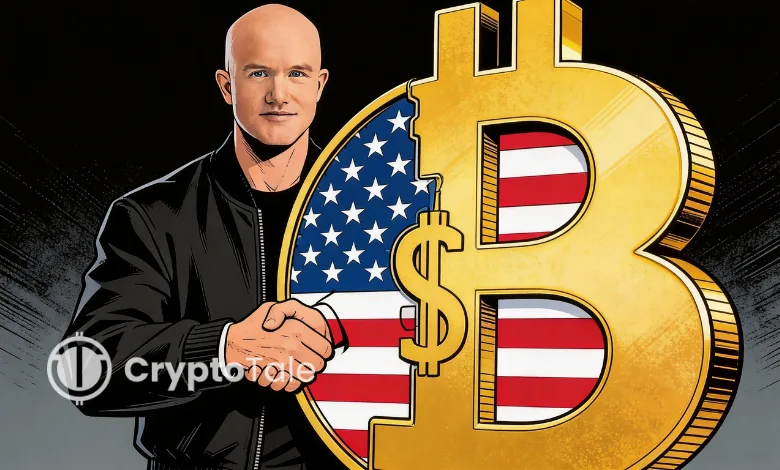
- U.S. regulators ease crypto enforcement as agencies move toward more explicit rules for Bitcoin.
- Brian Armstrong says Bitcoin competition pressures policy and supports dollar stability.
- Congress and courts curb the SEC’s reach as laws place Bitcoin under clearer commodity oversight.
U.S. regulatory attitudes toward Bitcoin have softened in 2025 as officials signal clearer rules and reduced enforcement pressure. The current court rulings, agency regulations, and congressional discussions now consider Bitcoin as a component of the financial system and no longer a threat.
Coinbase CEO Brian Armstrong has added to that shift by linking Bitcoin to U.S. dollar strength. According to him, Bitcoin poses a challenge that compels policymakers to be fiscally responsible. Armstrong argued that this dynamic can help preserve confidence in the dollar during periods of economic stress.
In a recent interview with Rick Rubin on the Tetragrammaton podcast, Armstrong said Bitcoin acts as a check on inflation and deficit spending. He explained that investors often move to Bitcoin when uncertainty rises. That movement, he said, encourages policymakers to avoid decisions that weaken the dollar.
Armstrong noted that moderate inflation can align with economic growth. However, he warned that inflation exceeding growth risks undermining reserve currency status. He said losing that position would deal a major blow to the United States economy.
He added that Bitcoin indirectly influences the Federal Reserve and regulatory behavior. According to Armstrong, policymakers remain mindful of confidence risks when alternative assets attract capital. He concluded that Bitcoin may help extend U.S. economic stability “in a strange way.”
U.S. Debt Pressures and Bitcoin’s Growing Role
The comments come as U.S. debt levels continue to rise rapidly. Government data shows the national debt is near $38.4 trillion. The figure increases by more than $70,000 every second.
That pace equals roughly $4.25 million per minute. Analysts have warned that sustained borrowing could strain confidence in the dollar over time. Market participants increasingly track Bitcoin and gold during periods of fiscal concern.
In early October, JPMorgan described Bitcoin and gold as part of a “debasement trade.” The bank cited uncertainty around long-term dollar stability. Bitcoin later surged to a high above $126,000 before pulling back.
Since that peak, Bitcoin has fallen about 30% to near $88,000. Gold has continued to climb and recently reached a record $4,545 per ounce. The diverging moves reflect different hedging behaviors among investors.
The Trump administration has also made symbolic moves in the direction of integrating Bitcoin. An executive order creating a Strategic Bitcoin Reserve was signed by the White House in March. Several lawmakers said the move could help address long-term debt challenges.
The reserve currently holds only seized Bitcoin. It does not include active purchases. Meanwhile, the Bitcoin Act of 2025 remains under early review in Congress.
Regulators and Lawmakers Signal a New Crypto Era
Beyond debt concerns, regulatory changes have reshaped Bitcoin’s outlook. U.S. agencies have eased enforcement actions during 2025. Officials now emphasize rulemaking over litigation.
The Securities and Exchange Commission launched a Crypto Task Force early this year. The group requested public input and dismissed several high-profile cases. Staff guidance also clarified digital asset custody standards.
The Commodity Futures Trading Commission issued no-action letters in December. These allowed Bitcoin and Ether to serve as collateral. The agency also began a pilot program for tokenized assets.
Related: Bitcoin Alone Is Ideal for US Reserves: Brian Armstrong
At the banking level, the Office of the Comptroller of the Currency approved charters for crypto-focused firms. Regulators provided clearer paths for banks to engage with digital assets. Agencies also dropped older cases tied to past policies.
These developments mark a break from earlier crackdowns. Regulators now frame crypto within established financial oversight. Bitcoin has benefited from commodity treatment and expanded ETF approvals.
Armstrong welcomed these changes during his podcast appearance. He said regulatory certainty strengthens economic power. He added that clear rules support growth for firms, investors, and institutions entering the market.