India and EU Deal Could Shift Crypto Liquidity and Flows

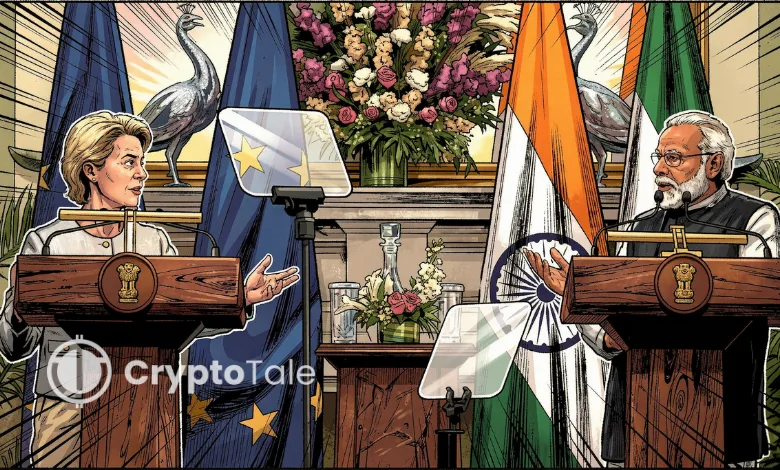
- EU-India trade pact expands services scope, bringing crypto market rules into focus.
- India’s strict crypto taxes face pressure as EU trade deal highlights regulatory gaps.
- Global trade tensions raise the deal’s value as India and EU hedge against U.S. tariffs.
India and the European Union finalized a free trade agreement, after talks began in June 2022. The pact links two markets covering about two billion people and 25% of global GDP. Beyond tariffs, the agreement expands services and trade rules, placing digital finance and crypto regulation under sharper focus.
Trade Pact Sets a Broader Policy Framework
The agreement removes or reduces tariffs on more than 96% of EU goods exports to India. Notably, it targets wine, olive oil, chocolate, pastries, machinery, chemicals and vehicles. EU officials estimate annual duty savings near €4 billion, while projections show EU exports to India could double by 2032.
However, the pact does not take effect immediately. European Parliament and Council approvals remain pending and could take at least a year. Until ratification, firms must plan around transitional rules, which shapes how cross-border services may comply.
Because the deal spans goods, services, and trade rules, it creates a wider policy container. This structure increasingly includes digital businesses, payment platforms, and crypto service providers. As a result, regulatory clarity becomes more visible within the trade framework.
EU leaders described the accord as the “mother of all deals.” Indian Prime Minister Narendra Modi echoed that description during India Energy Week. Meanwhile, European Commission President Ursula von der Leyen called it a partnership between two economic giants.
Alongside trade, both sides agreed on defense cooperation and mobility for skilled workers and students. Consequently, fintech and compliance talent mobility also becomes part of the broader relationship. This context matters for firms navigating digital asset operations across borders.
Crypto Rules Face Pressure Ahead of Budget 2026
India’s crypto industry already faces a strict tax regime. Current rules impose a flat 30% tax on virtual digital asset gains. In addition, authorities apply a 1% tax deducted at source on transactions.
Industry players say these rules are pushing traders to overseas platforms, where users often have fewer protections. Because of this, pressure to revisit crypto taxes is growing as Budget 2026 approaches.
At the same time, the EU–India free trade agreement has drawn attention to gaps in digital finance rules. Many European investors prefer clear compliance standards before entering a market, so clearer crypto rules could fit naturally with the deal’s services section.
The timing adds urgency. Budget 2026 comes after the FTA was agreed but before it is fully approved, putting policymakers under pressure to address digital asset rules as trade ties deepen.
Crypto exchanges and stablecoin firms already function like payment and service providers, yet India still does not have a specific crypto law. While the trade deal does not force crypto reform, it makes regulatory uncertainty more costly.
European fintech companies usually operate under clear frameworks like MiCA. As cross-border digital services grow, differences in regulation are becoming harder to ignore. Thus, regulatory definition becomes a practical issue, not a political statement.
Related: India Tightens Rules on Privacy Cryptos Over Laundering Risks
Global Trade Tensions Shape the Deal’s Context
The agreement comes amid increased global trade friction. U.S. President Donald Trump has pursued aggressive tariff policies, affecting both India and the EU. These actions disrupted trade flows and accelerated alternative partnerships.
Hosuk Lee-Makiyama, director at the European Centre for International Political Economy, described the deal as highly valuable. He noted both India and the EU have historically protected strategic sectors. According to Lee-Makiyama, limited options made this agreement especially important.
U.S. officials reacted critically. Treasury Secretary Scott Bessent cited U.S. tariffs on India over Russian oil purchases. He questioned Europe’s decision to advance a major deal under those conditions.
Trump, now the 47th U.S. president, has not commented publicly. However, officials in Washington expressed little expectation of approval. Meanwhile, Indian officials stressed continued engagement with the United States.
Petroleum Minister Hardeep Singh Puri told CNBC that a U.S.-India trade deal remains advanced. He urged calm and emphasized India’s open trade stance. This response framed the EU pact as part of a broader strategy.
Market conditions remain volatile. After Davos 2026 and renewed trade tensions, Bitcoin traded below $88,000. While unrelated directly, digital asset markets reflect broader geopolitical uncertainty.
India and the EU finalized a far-reaching trade agreement that influences goods, services, and trade rules across two major markets. The pact places regulatory attention on digital services, including crypto amid India’s existing tax framework. As Budget 2026 nears, trade integration, regulatory clarity and global tensions remain closely linked.