Trump’s Pope Leo Lecture Turns Iran Row Into New Theater

- Trump turned a grave Iran dispute into another late-night performance for attention.
- His attack on Pope Leo widened a feud shaped more by ego than disciplined statecraft.
- The episode fused nuclear alarm with swagger and left Trump looking thin-skinned.
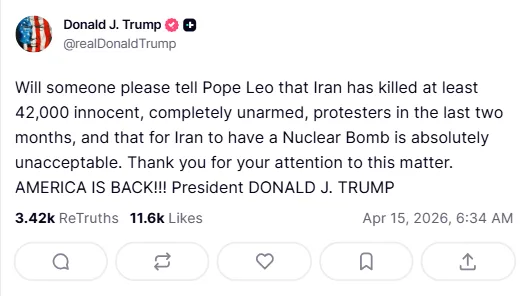
U.S. President Donald Trump renewed his attack on Pope Leo XIV late Tuesday, accusing the pontiff of overlooking Iran’s crackdown while defending his hard line on Tehran. In a Truth Social post, Trump said Iran had killed at least 42,000 unarmed protesters in two months and declared an Iranian nuclear bomb “absolutely unacceptable.” The exchange widened a public dispute over Iran, ceasefire calls, and U.S. military policy.
The post itself is real, and the broader context is clear: Trump was lashing out at a pope who has condemned the U.S.-Israeli war on Iran and warned against moral decay in politics. But Trump’s statement is not a serious moral argument. It is political opportunism wrapped in outrage.
Trump Reignites Clash With Pope Leo
Trump’s midnight post followed another attack on Sunday. Then, he said he did not want a pope who criticized the U.S. president. The new message built on Trump’s criticism of Leo over his objections to U.S. military actions against Iran and Venezuela. He also asked that someone tell Leo about Iran’s actions.
Pope Leo had already called for a ceasefire and urged dialogue to resolve the Iran conflict. On Monday, he told reporters he had no fear of the Trump administration. He said he would keep speaking out loudly against war and keep promoting dialogue and multilateral relations among states. He also said he wanted just solutions to problems.
The confrontation left one question at the center of the story: could Trump’s Iran message stand apart from his growing feud with a pope calling for peace? Reuters reported the U.S.-Israeli attack on Iran began on February 28. It also reported thousands of deaths and the displacement of millions.
AI Image Row Deepens Religious Backlash
Trump also drew fire on Sunday after posting an AI-generated image of himself appearing like Jesus Christ on Truth Social. Religious leaders and Democratic lawmakers condemned the image. The Vatican then called the imagery “deeply disrespectful.” The image appeared on the same platform where Trump attacked Leo.
Megan Basham, a conservative Christian commentator, also attacked the post. In a message on X, she said she did not know whether Trump thought he was being funny. She also called the image “OUTRAGEOUS blasphemy.”
Trump later deleted the image and gave a different explanation at the White House. He said the picture showed him as a doctor and linked it to the Red Cross. He also rejected reports that he had cast himself as Jesus and blamed the “fake news.” He added that he makes people “a lot better.”
Related: Bessent Reveals Trump’s Bank Citizenship Order Is in Process
Iran Claims Renewed Focus on Trump’s Record
Trump’s post centered on Iranian civilian deaths during the regime’s crackdown. At the same time, it reopened scrutiny of the wider war and Washington’s role in it. Pope Leo’s public position remained centered on ceasefire, dialogue, and just solutions.
The supplied text also tied Trump’s warning to Iran’s nuclear program. It cited the IAEA chief saying any agreement would need very detailed verification. It also cited AP reporting that Iran had 440.9 kilograms of uranium enriched to 60%. The amount sat close to weapons-grade material, according to the text.
Iran still denies it seeks a nuclear bomb and remains in the Nuclear Non-Proliferation Treaty. Trump nevertheless said an Iranian bomb was “absolutely unacceptable.” Reuters, as referenced in the text, said Trump’s 2018 exit from the JCPOA raised conflict risks and unsettled allies. That history returned as Trump again framed Iran’s nuclear threat as urgent.
So yes, Trump deserves criticism here, and severe criticism at that. He is taking genuine Iranian suffering and converting it into a prop for personal combat with a religious leader who opposes war. He is treating an atrocity as a talking point, uncertainty as certainty, and foreign policy as a stage for grievance politics. The most damning part is not that he condemns Iran’s brutality. He should. It is that he does so in a way that is careless with facts, reckless with power, and empty of the moral seriousness he pretends to defend.