
US Bitcoin ETFs Shed $171M as IBIT Leads Daily Outflows


- US Bitcoin ETFs logged a $171.22M outflow as March 26 selling widened sharply again.
- BlackRock’s IBIT led withdrawals, though its long-run inflow base stayed dominant.
- Broad redemptions spread across issuers while total assets held near $88.36B overall.
U.S. Bitcoin spot ETFs recorded a $171.22 million net outflow on March 26, according to SoSoValue. The withdrawals spread across major issuers, led by BlackRock, Bitwise, Fidelity, and Grayscale. Even so, cumulative net inflows stood at $56.16 billion, daily trading volume reached $2.49 billion, and total net assets held at $88.36 billion, equal to 6.40% of Bitcoin’s market capitalization.
BlackRock Led the Daily Pullback
BlackRock’s IBIT posted the largest one-day outflow at $41.92 million. Even after that move, IBIT still held $63.30 billion in cumulative net inflows and $53.76 billion in net assets. The fund traded at $38.82, fell 3.36%, carried a 3.89% cash holding ratio, charged a 0.25% fee, and showed a slight 0.02% premium.
IBIT also led trading activity with $1.71 billion in daily volume. That made it the most active fund in the group during the session. The data shows that heavy trading coincided with the day’s largest redemption.
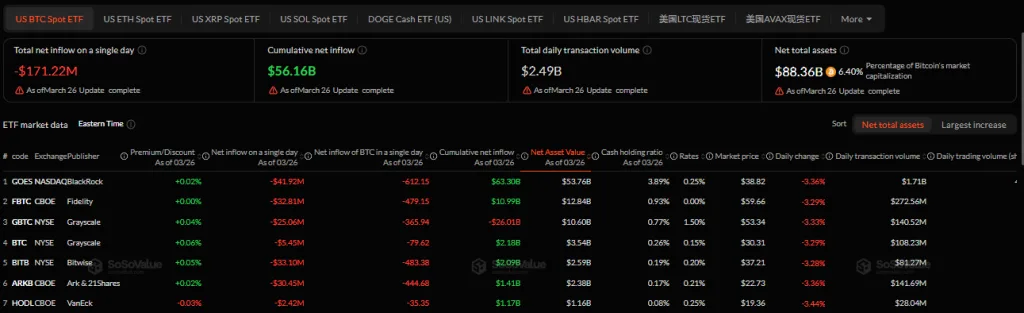
Bitwise’s BITB recorded the second-largest daily outflow at $33.10 million. BITB held $2.09 billion in cumulative inflows and $2.59 billion in net assets. Its price fell 3.28% to $37.21.
Fidelity’s FBTC followed with a $32.81 million outflow. It maintained $10.99 billion in cumulative inflows and $12.84 billion in net assets. FBTC traded at $59.66, slipped 3.29%, posted $272.56 million in daily volume, and kept a neutral premium position.
Grayscale’s GBTC lost $25.06 million and kept a cumulative net flow of negative $26.01 billion. Its net asset value stood at $10.60 billion, its price fell 3.33% to $53.34, and its fee rate was 1.50%. A secondary Grayscale BTC listing posted a $5.45 million outflow, with $2.18 billion in cumulative inflows and $3.54 billion in assets.
Related: Bitcoin Crash Tied to IBIT Dealer Hedging, Says Arthur Hayes
ARKB, issued by Ark & 21Shares, logged $30.45 million in outflows and showed $1.41 billion in cumulative inflows. VanEck’s HODL posted a smaller $2.42 million outflow and $1.17 billion in cumulative inflows. Across the listed funds, daily price losses stayed above 3%, while premium and discount levels remained close to parity.
Flows Became a Key Market Signal
Spot Bitcoin ETFs won U.S. SEC approval in early 2024 and became a major route for traditional finance into crypto. Because of that role, daily flow data now serves as a key sentiment gauge. The supplied text says a swing from inflows to outflows within one day often aligns with macro data, rate expectations, or Bitcoin price volatility.
Historically, the text says sustained inflows tend to track bullish price momentum and positive news cycles. Sudden outflows can precede or accompany market corrections. Will this broad one-day retreat extend into a weekly trend?
The same text says one session of net outflows does not define a lasting trend. Still, the breadth of withdrawals across leading funds points to a wider short-term shift in risk appetite. Aggregate holdings remain substantial, with billions of dollars in Bitcoin still under management.
The text also describes an interdependent link between ETF flows and Bitcoin’s spot price. Large inflows can create buying pressure because authorized participants must acquire Bitcoin to issue new ETF shares. By contrast, net outflows can add selling pressure when funds redeem shares and release Bitcoin. The March 26 exit, the text says, likely added to spot-market pressure and may have deepened any existing decline.