XRP Holds Crucial Support as On-Chain Data Hints at March Rally


- XRP steadies above key support as selling pressure cools across major exchanges.
- On-chain metrics show capitulation easing while March seasonality signals strength.
- Technical levels highlight $1.30 as the pivot for any early-month recovery attempt.
XRP spent the first two months of 2026 grinding lower, unable to shake off a downtrend that set in at the start of January. Attempts to break through heavy resistance zones faded quickly, leaving the asset stuck beneath levels that traders once treated as routine. Market sentiment hasn’t helped either.
Lingering macro tension and expanding geopolitical uncertainty have pushed investors toward safer corners of the sector and drained momentum from most altcoins. Even so, the XRP price managed to claw back above the $1.30 support level after slipping beneath it over the weekend. It held near $1.36 by early Monday, though still down roughly 4% on the day.
Besides, the broader backdrop remains tense: the market sits in an “Extreme Fear” phase, Bitcoin dominance continues to rise, and the CMC Altcoin Season Index slid to 34 within 24 hours. Traders pointed to the same rotation affecting other speculative names, such as PIPPIN, which has struggled under shifting risk appetite.
Escrow Unlock Adds to Supply Pressure
Similarly, Ripple’s March 1 unlock of 1 billion XRP did not spark immediate volatility, but it left a noticeable shadow over the tape. In softer conditions, fresh supply tends to settle slowly. Analysts noted that these events often weigh on recovery attempts when demand is already thinning across the board.
The effect this time appears muted but persistent. With liquidity pockets already shallow, additional tokens in circulation add friction to any upside move. Several market desks compared the behavior to broad alt pressure earlier this year, when smaller tokens like PLUME saw rallies fade under comparable supply dynamics.
Capitulation Metrics Approach Turning Zone
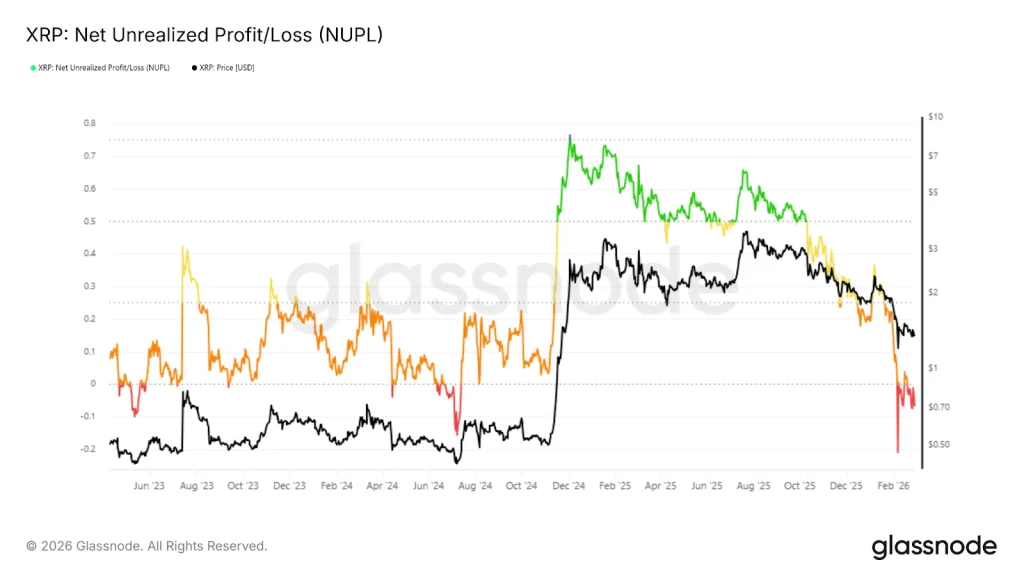
Meanwhile, on-chain data paints a picture of holders staying underwater. The Net Unrealized Profit and Loss gauge shows XRP deep in capitulation territory, a zone that historically forms near the end of a downtrend rather than the start. In previous years, these phases lasted close to a month.
Source: Glassnode
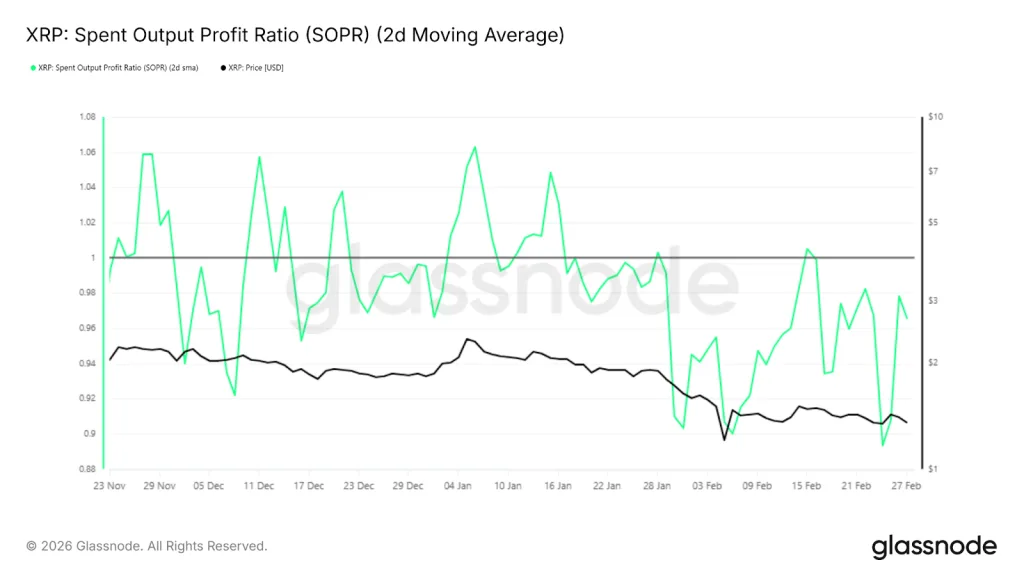
The current stretch began in early February, leaving analysts watching the calendar as much as the chart. The SOPR reading, another measure of whether investors are selling at a gain or loss, remains below 1. That signals realized losses still dominate trading.
Source: Glassnode
A brief push above that line in mid-February vanished almost as quickly as it arrived. Traders say a convincing break above 1 tends to coincide with early recovery stages, often marking the moment selling pressure exhausts itself. On the same accord, seasonality has long been part of XRP’s narrative.
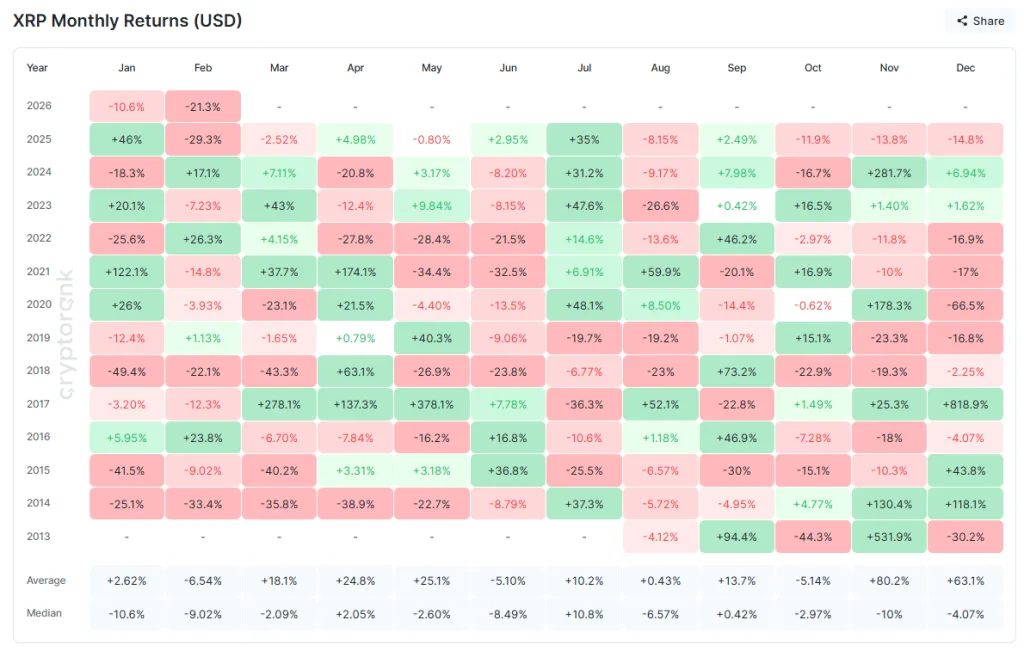
Over the past 12 years, March has delivered an average return near 18%, making it the strongest month in the first quarter. However, traders hesitate to lean too heavily on historical tendencies this year, given heightened global tension involving the United States and Israel.
Source: CryptoRank
Even minor shocks in broader financial markets have been enough to delay risk flows into altcoins, while assets with speculative profiles such as PIPPIN continue to see sharper whiplash.
Related: Pippin Price Dives 33% After New Peak of $0.8964: What’s Ahead Now?
Key Technical Levels in Focus
For now, the $1.30 floor remains the line to watch. Holding it keeps the door open for a push toward the 23.60% Fibonacci marker at $1.42. Clearing that level sets up a move toward the 38.20% Fib zone near $1.61, with the 50% level at $1.76 forming the next waypoint.
Moreover, the RSI, once buried in oversold territory, now sits around 40, an early sign that conditions may be stabilizing. A decisive breakdown, however, would open space toward $1.11, last visited on February 6.The market doesn’t appear to be in free fall, yet conviction remains thin. As March begins, XRP price stands at a crossroads defined by support resilience, cooling capitulation, and seasonality that could help if global conditions stop tightening long enough for buyers to breathe.