Putin Claims U.S. Interest in BTC Mining at Zaporizhzhia Plant

- Putin says U.S. interest in Bitcoin mining is tied to talks over Zaporizhzhia plant control.
- Conflicting U.S., Russia, and Ukraine proposals stall decisions on the nuclear facility.
- Power security, safety rules, and legal limits complicate Bitcoin mining at the site.
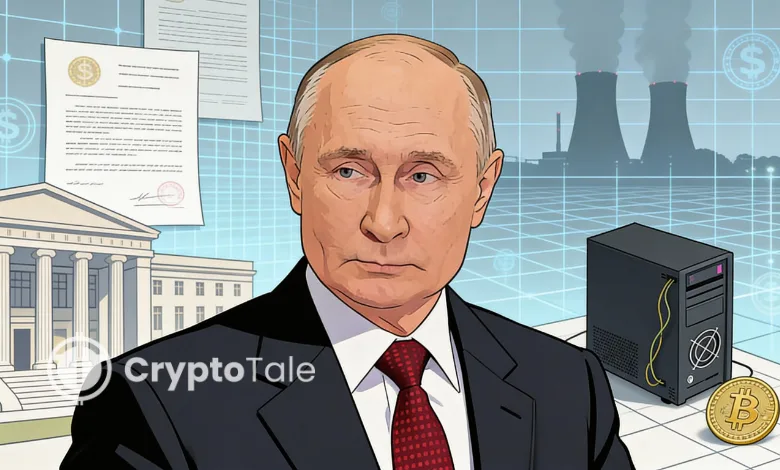
Russian President Vladimir Putin said the United States has shown interest in cryptocurrency mining at the Zaporizhzhia Nuclear Power Plant, according to Kommersant. The claim links Bitcoin mining to negotiations over Europe’s largest nuclear facility. The plant has been under Russian control since 2022 and remains central to talks on energy security, territorial disputes, and peace efforts.
The Zaporizhzhia Nuclear Power Plant is located in southeastern Ukraine. Before the conflict, it played a major role in Ukraine’s electricity supply. Since its occupation, the plant has become a persistent source of tension. Decisions over its control affect power distribution and regional grid stability.
Competing Proposals Shape Zaporizhzhia Talks
Kommersant reported that U.S. interest in crypto mining is linked to discussions about a possible stake in the plant. The report said the topic emerged during contacts between Russian officials and U.S. representatives. It did not cite documents or official statements from Washington.
Other outlets have described different proposals for managing the facility. Kommersant said Russia is discussing a joint management arrangement with the United States that would exclude Ukraine. Under this approach, Kyiv would have no operational role.
The BBC reported that the United States proposed a three-party framework. That plan would give equal stakes to the United States, Russia, and Ukraine. No confirmation has been issued that such a structure has been accepted by any side.
Ukraine has advanced a separate counterproposal. Reuters reported that Kyiv suggested a joint venture between Ukraine and the United States. Each side would hold a 50% stake. Ukraine would receive half of the electricity generated at the plant.
Under the same proposal, the United States would manage the remaining output. Euronews reported that Ukrainian officials assume part of that share could be allocated to Russia. This assumption has not been confirmed by U.S. officials.
Control of the plant determines who manages a major source of electricity. It also influences regional energy security and nuclear safety.
Related: Russian Central Bank Shifts Tone on Bitcoin Mining Role
The issue arises as the Russia-Ukraine war moves into its fourth year. U.S. President Donald Trump has increased diplomatic engagement aimed at securing a ceasefire. Talks have focused on territory, security guarantees, and economic arrangements linked to energy and reconstruction.
Peace Talks Advance as Crypto Mining Draws Scrutiny
Ukrainian President Volodymyr Zelenskiy said Ukraine and the United States are closer to a potential 20-point peace framework. Reuters reported the statement following renewed discussions. Russia has also indicated willingness to make concessions, while maintaining firm positions on disputed regions such as Donbas.
Washington has not commented on the claim involving Bitcoin mining at the nuclear plant. No U.S. agency has confirmed involvement in crypto-related talks tied to the facility. The lack of response leaves the report unverified.
Energy analysts note growing global interest in linking power generation with crypto mining. Bitcoin’s network hashrate is at record levels. Mining firms continue to seek stable and low-cost electricity sources.
Several countries already use excess electricity for crypto mining. Russia, Iran, and parts of Central Asia have promoted mining as a way to monetize unused capacity.
Experts warn that mining near a nuclear facility would raise serious challenges. Nuclear plants operate under strict safety and regulatory rules. Adding large-scale computing infrastructure could complicate oversight, even outside a conflict zone.
The discussion also comes as Bitcoin’s supply continues to tighten. The asset has a fixed maximum supply of 21 million coins. Around 19.9 million bitcoins have already been mined. And fewer than 1.03 million remain.
After the 2024 halving, miners earn 3.125 BTC per block. Roughly 450 new Bitcoins are produced each day. At the current pace, the final bitcoin is expected to be mined around 2140.