Ethereum Factor Model: A Bitwise Report on What Drives Ethereum’s Price


- Bitwise says Bitcoin explains about 65% of Ethereum’s weekly return variance since May 2018
- Financial conditions emerged as Ethereum’s second-strongest driver, peaking near 40% impact
- ETP flows remained statistically reliable, but the effect on Ethereum returns stayed modest
Ethereum’s market story is not being written by on-chain growth alone. In a report by Bitwise Senior Research Associate Max Shannon, the asset manager said the token’s weekly returns have been driven primarily by Bitcoin, with broader financial conditions emerging as the most important secondary force over the past year.
Using 406 weekly observations starting in May 2018, Bitwise built a factor model to isolate the variables that have mattered most and to show how their influence has changed across market cycles. The findings frame Ethereum less as a stand-alone cash-flow asset and more as a market-sensitive crypto instrument whose price is still heavily tied to Bitcoin’s direction.
That conclusion stands out as it arrives at a time when the network’s fundamentals appear stronger: U.S. regulatory clarity has improved, institutional access has expanded through spot and CME futures markets, stablecoins on the chain account for roughly half of a $300 billion market, and tokenized assets on the network represent about 60% of a $25 billion sector. Yet despite that backdrop, ETH remains about 62% below its all-time high, according to the report.
Bitcoin Remains the Main Price Engine
Bitwise reported that Bitcoin is still the dominant force behind Ethereum returns, with the model showing an almost 1:1 weekly relationship between the two assets. The BTC coefficient stood near 0.99, while Bitcoin alone explained about 65% of ETH’s return variance.
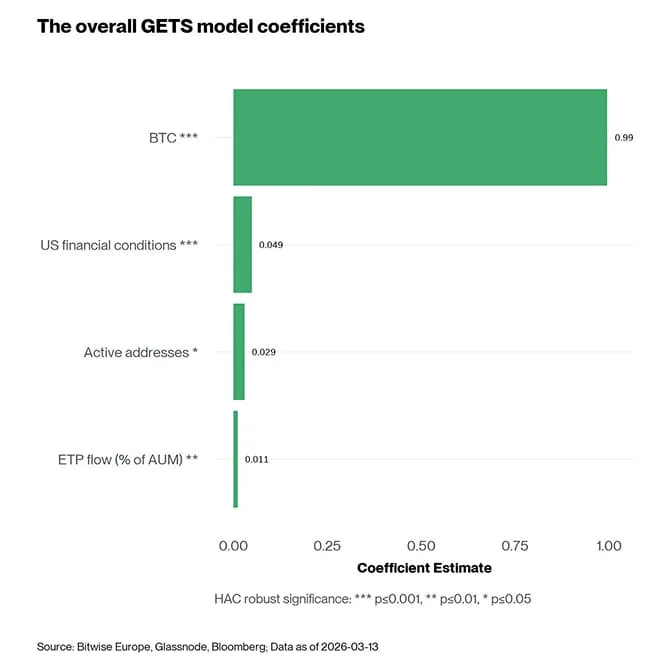
In practical terms, that means broad crypto market direction, rather than network-specific developments, has accounted for most of the asset’s price movement. The report said the Bloomberg US Financial Conditions Index was the second most important variable.
Its coefficient was about 0.05, and its explanatory power averaged 11.3%, rising to roughly 40% at peak periods. That made financial conditions a time-varying but meaningful driver, especially in recent market regimes where looser liquidity conditions added support beyond Bitcoin’s influence.
Why Fundamentals Carry Less Weight Than Expected
Notably, network activity had a measurable but smaller role. Active addresses carried a coefficient of about 0.03, with average explanatory power near 6% and peaks around 30%. Bitwise said this suggests adoption metrics do matter, but not nearly as much as many market participants assume when explaining price performance.
The report went further by arguing that revenue metrics have been even less relevant. In its methodology, Bitwise said revenue was removed from the final GETS model because it behaved more like noise than signal at weekly frequency. That result supports the view that the market has priced Ethereum more like a network-driven commodity than a business with durable cash flows.
The firm added that its long-term cycle indicator now sits at the 6th percentile, while the price-to-sales ratio stands at the 99th percentile, reinforcing the disconnect between fundamentals and valuation.
ETP Flows Signal Demand, Not Price Power
Bitwise also found that ETP flows, measured as a percentage of assets under management, had a small coefficient of about 0.01 but remained highly statistically significant. On average, they explained around 10% of the variance and reached 40% at peak periods. The report described flows as a dependable price signal rather than a major return driver.
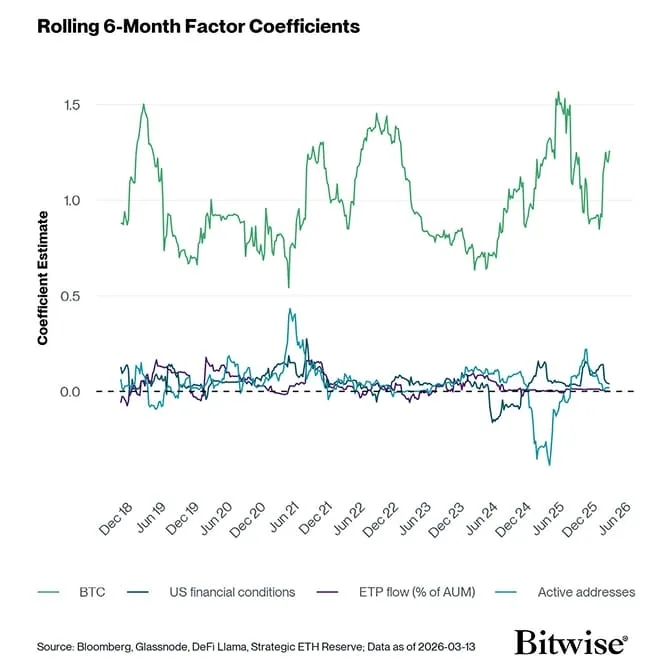
That pattern became especially visible in the current regime. Bitwise said ETP flows were significant in 91% of weeks, the most statistically reliable flow-price relationship in ETH history. Even so, their effect per unit was lower than in earlier cycles, meaning flows have become persistent and informative, but not especially forceful.
Related: Ethereum’s 8-Year Convergence Suggests 2026 Altcoin Season Could Top 2021
A Useful Explanatory Model, With Limits
Model diagnostics showed no major misspecification and little serious overlap among retained factors, meaning each variable contributed distinct information. Still, when the framework was tested for forecasting, the report found that its out-of-sample performance did not beat a simpler AR(1)+BTC model.
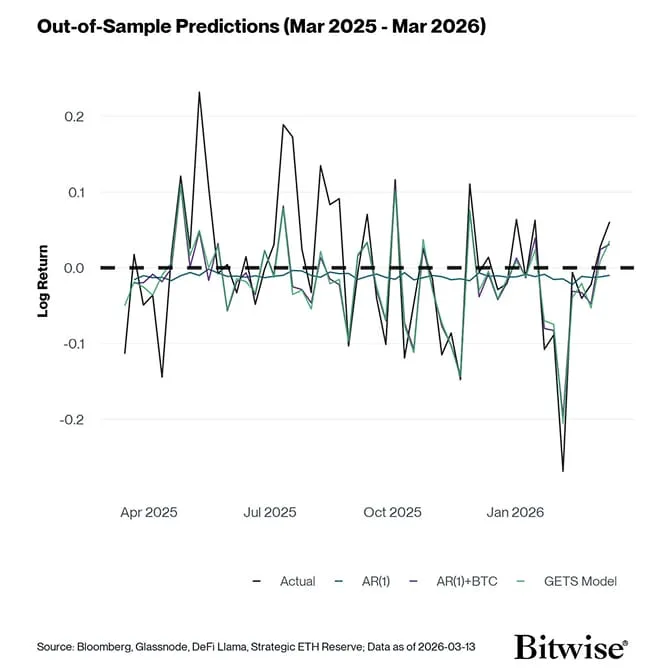
According to Bitwise, that means the extra factors help explain past returns, but short-term prediction is still largely captured by Bitcoin exposure and price momentum. In that sense, the report’s central message was clear: for now, Ethereum’s price remains primarily a Bitcoin-led market trade, with macro conditions, cyclical network activity, and steady ETP flows shaping the margins rather than the core.