
Bitcoin Fear Hits 5-Week High as Standard Chartered Backs $500K by 2030


- Standard Chartered kept its $500K Bitcoin and $40K Ethereum targets for 2030.
- Santiment logged the most bearish Bitcoin social sentiment since February 28.
- Ethereum’s implied upside topped Bitcoin’s, while dominance data fueled altcoin focus.
A renewed long-term forecast from Standard Chartered is drawing attention at a time when market sentiment has turned sharply cautious. A clip shared by Milk Road on X showed Geoffrey Kendrick, the bank’s global head of digital assets research, reaffirming a 2030 target of $500,000 for Bitcoin and $40,000 for Ethereum.
The call landed as Santiment reported the weakest bullish-to-bearish discussion ratio for Bitcoin since Feb. 28. The analytics firm said social data across X, Reddit, Telegram, and other platforms showed just 0.81 bullish comments for every one bearish comment on Saturday.
Standard Chartered Restates Its Long-Term Targets
Kendrick’s projection does not represent a fresh reversal in outlook. Initially, the bank had already maintained its $500,000 2030 target after trimming its nearer-term Bitcoin expectations in December 2025.
Those earlier revisions cut the bank’s 2025 and 2026 targets in half, to $100,000 and $150,000, respectively. That change effectively pushed the original path back by two years while preserving the longer-term ceiling.
Meanwhile, the Ethereum view was set out more clearly in Standard Chartered’s January 2026 research. That note argued that ETH could outperform Bitcoin for the rest of the decade, citing tokenization, stablecoins, and institutional blockchain adoption.
The latest podcast remarks kept that broader framework intact. Rather than change course, Kendrick repeated a roadmap that the bank has continued to defend despite scaling back short-term expectations.
Ethereum’s Upside Looks Larger in Percentage Terms
The headline number belongs to Bitcoin, but the percentage math favors Ethereum. Using the prices cited in the discussion, Bitcoin at $66,400 would rise to about 7.5 times that level if it reached $500,000.
Ethereum, on the other hand, priced at $2,034, would need to climb nearly 20 times to meet the $40,000 target. That makes its implied return almost three times Bitcoin’s, on a relative basis. Kendrick also pointed to the ETH/BTC ratio as a useful gauge.
That ratio is currently around 0.03, and his near-term outlook calls for it to move toward 0.04. He also outlined a nearer checkpoint for both assets. If Bitcoin returns to $100,000 by the end of 2026, Ethereum should trade near $4,000, implying gains of roughly 50% and 95%.
Market Sentiment Has Turned Noticeably Defensive
That bullish long-term framing contrasts with much weaker present-day positioning across crypto discussions. Santiment said the latest social reading marked the highest level of bearish commentary since late February.
The firm described the market as showing the highest levels of fear, uncertainty, and doubt since that period. At the weakest point, it said there were roughly five bearish comments for every four bullish comments.
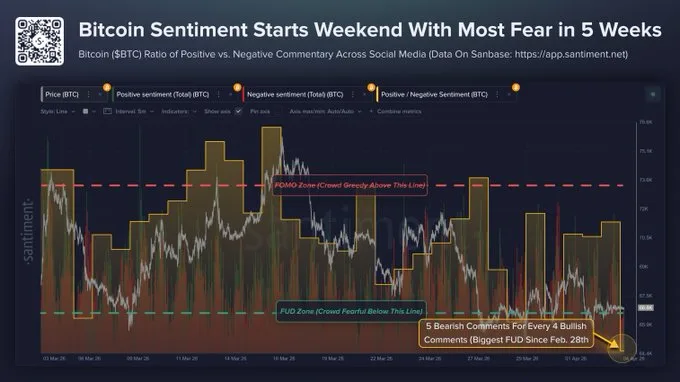
Santiment linked the cautious mood to a prolonged stretch of stagnation across crypto markets in 2026. It also cited uncertainty related to the war in Iran and the Clarity Act.
Even so, the firm did not frame the shift as a collapse in participation. Instead, it said periods of heavy crowd pessimism have historically aligned with rebound conditions in crypto markets.
Related: XRP Consolidates at Key Support as Transactions Hit 2025 Low
Bitcoin Dominance Debate Adds Another Layer
A separate market signal came from analyst Crypto Patel, who focused on Bitcoin dominance rather than price. Patel said dominance was nearing a long-term resistance area he called the Altcoins Accumulation Line. His chart compared the current setup with prior cycle peaks.
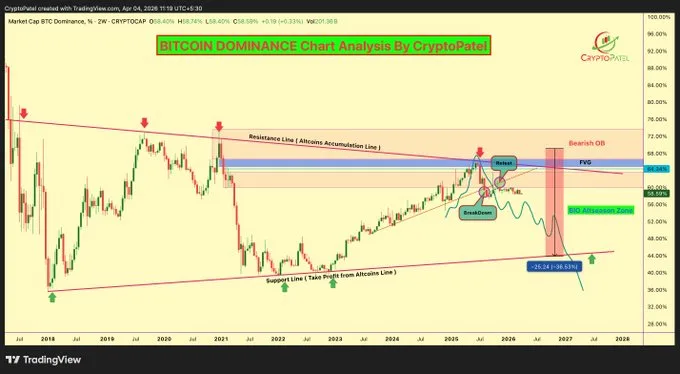
It showed that dominance was rejected at above 72% in 2018 and above 73% in 2021, before dropping sharply afterward. In the current cycle, Patel’s dominance was near 64.24%. He said the structure now reflected a retest near resistance, followed by the early stages of a breakdown.
According to Patel, that pattern would indicate capital rotation into altcoins rather than continued concentration in Bitcoin. Combined with Kendrick’s long-term targets and Santiment’s fear data, the market now presents sharply split signals across price forecasts, sentiment, and positioning.