
Venezuela’s Shadow Bitcoin Reserve May Rival Strategy

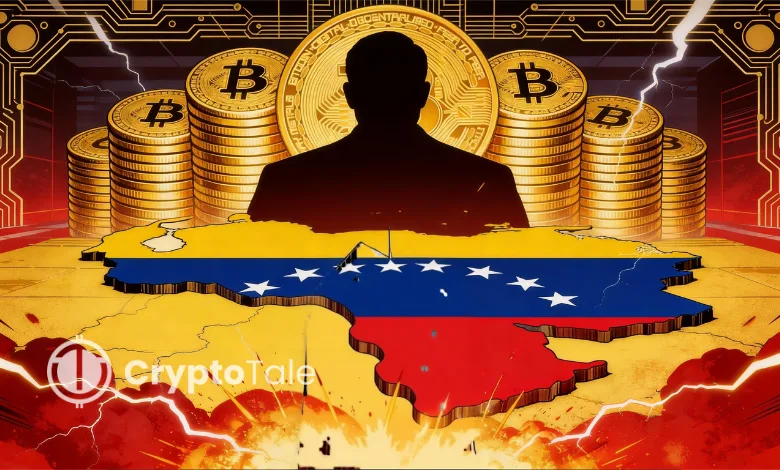
- Maduro arrest fuels scrutiny of alleged $60B–$65B Venezuelan Bitcoin stash claims.
- Venezuela’s crypto use grew from sanctions, hyperinflation, and collapsed banking.
- Markets watch seizure risk as any large BTC liquidation could pressure supply prices.
The arrest of Nicolás Maduro on Jan. 3 has led to renewed scrutiny of Venezuela’s alleged Bitcoin holdings. U.S. President Donald Trump announced the capture on Truth Social, confirming Maduro’s extradition from Venezuela to the United States. Since then, reports and social media discussions have focused on claims that Venezuela controls a hidden Bitcoin reserve worth up to $65 billion.
Arrest Shifts Focus to Alleged State Bitcoin Holdings
Following Maduro’s arrest, attention shifted from geopolitics to Venezuela’s possible crypto exposure. Notably, several reports suggested the country controls a so-called “shadow” Bitcoin reserve held outside public wallets. According to WION, estimates place the reserve near $65 billion, while CoinDesk cited figures closer to $60 billion.
If accurate, those levels would rival the holdings of Michael Saylor’s Strategy, formerly MicroStrategy. Strategy currently holds 673,783 BTC, valued above $62 billion after adding 1,287 BTC between Jan. 1 and 4.
How Sanctions and Economic Collapse Drove Crypto Use
Venezuela’s use of crypto grew out of survival needs not investment plans. Hyperinflation, strict capital controls, and sanctions weakened banks and cut off access to global finance. As a result, both citizens and institutions turned to crypto as an alternative.
In 2018, Maduro introduced the petro, a government-backed digital currency linked to oil reserves. The goal was to work around U.S. sanctions and bring in foreign funding. However, the petro failed to gain adoption and was later abandoned.
As conditions worsened, stablecoins filled the gap. Dollar-pegged tokens supported daily commerce, remittances, and savings as the bolívar lost credibility. Over time, crypto became embedded in informal and state-linked transactions.
According to intelligence cited by researchers Bradley Hope and Clara Preve, accumulation may have followed. They reported Venezuela converted gold sales into Bitcoin starting around 2018. The gold reportedly came from the Orinoco Mining Arc.
Estimates suggest $2 billion in gold moved into Bitcoin near $5,000 prices. That conversion would equal roughly 400,000 BTC, now worth about $36 billion at early-2026 prices. Additional accumulation may have followed through oil settlements and seized mining operations.
Related: Bitcoin Holds Firm as Venezuela Shock Tests Market Strength
Market Attention Turns to Seizure and Supply Risks
With Maduro in U.S. custody, speculation has shifted toward asset seizure risks. Some market participants believe U.S. authorities could seize any discovered Bitcoin holdings. According to QCP Capital, seized BTC could enter a future U.S. strategic reserve.
QCP Capital noted that holding seized assets would reduce forced selling risk. The firm added that such actions underscore Bitcoin’s growing strategic relevance among governments.
However, officials have not confirmed any seizure plans. Analysts have outlined three potential outcomes. First, authorities could freeze the assets without movement. Second, the U.S. could retain them as a strategic reserve.
A third option involves liquidation through platforms like Coinbase Prime or U.S. Marshals auctions. However, analysts consider that scenario less likely given the past government handling of seized Bitcoin. Market participants remain focused on supply implications.
Germany’s sale of 50,000 BTC in 2024 caused a sharp market correction. By comparison, estimates suggest Venezuela could control over 600,000 BTC. Such figures have kept traders focused on potential supply shocks.
The arrest of Nicolás Maduro has reopened scrutiny of Venezuela’s crypto history and alleged Bitcoin holdings. Reports cite estimates between $56 billion and $67 billion, though no on-chain proof exists. Together, the claims, history, and seizure risks keep Venezuela central to current Bitcoin market discussions.