
Forex Trading vs Crypto Trading: A Beginner’s Guide


Throughout history, trading once meant exchanging goods directly. Today, an importer can buy foreign currency for an overseas payment, while a Bitcoin buyer can trade dollars for a digital asset at any hour. For beginners comparing forex trading vs crypto trading, the differences start with what changes hands, when a trade can take place, and who controls the asset afterward.
Both markets use pairs to express prices. The euro has a price in dollars, just as Bitcoin does. But an importer who buys euros can settle a supplier’s invoice. A buyer who holds Bitcoin instead takes on the risk that its dollar value will change before the buyer sells.
How Forex Trading vs Crypto Trading Works
A forex quote shows how much of one currency buys a unit of another. The first currency in the pair sets the unit. The second supplies the price. At a hypothetical EUR/USD rate of 1.1000, one euro costs $1.10, so €1,000 costs $1,100 before fees.
Suppose the rate rises to 1.1100. The same €1,000 now buys $1,110, giving the euro holder a $10 gain before costs. An American importer who still needs to buy those euros faces the other side of that move. The invoice now costs $10 more.
For that importer, timing is crucial. A spot deal sets the rate for near-term delivery. A forward contract lets a business agree on a rate today for a payment due later. The business then knows its dollar cost even if the euro moves before the invoice falls due.
The same math is used in cryptocurrency quotes. At a hypothetical BTC/USD price of $50,000, a $500 spot purchase buys 0.01 bitcoin before fees. If Bitcoin reaches $55,000, that fraction has a value of $550, but a fall to $45,000 cuts its value to $450.
What happens after the purchase distinguishes the two trades. A bitcoin buyer can leave the coins with a custodian or withdraw them to a personal wallet if the platform supports withdrawals. The wallet manages the private keys that authorize transfers. Whoever controls those keys can move the coins
Forex Market vs Crypto Market in Figures
The Bank for International Settlements put global over-the-counter forex turnover at $9.5 trillion per trading day in April 2025. Turnover counts the value of trades. That total includes spot deals and contracts such as forwards and swaps, which businesses and financial institutions also use to manage currency risk.
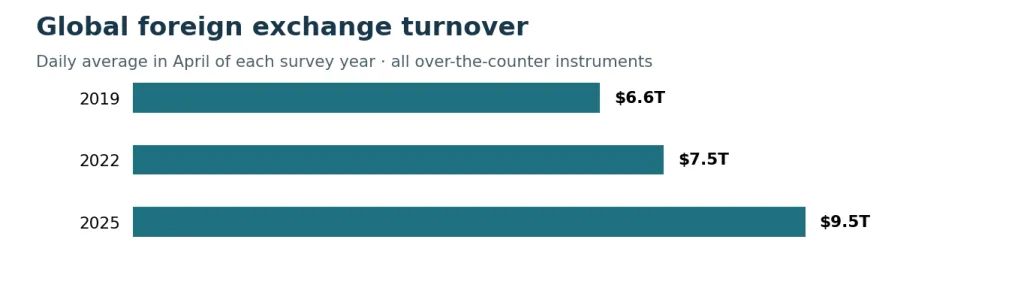
Source: BIS revised 2025 figures.
CoinGecko measured a different slice of trading. Its ten leading centralized crypto exchanges recorded $18.7 trillion in spot trades during 2025, up from $17.4 trillion in 2024. Those figures cover full years and exclude crypto derivatives and trades on decentralized exchanges.
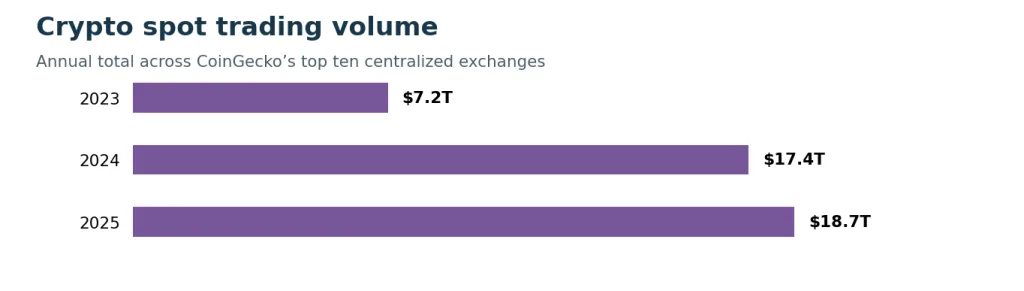
Source: CoinGecko’s 2025 annual reports.
The two charts show how activity changed within each market. A direct size comparison would require the same period and comparable types of trades. Neither chart measures how much money traders earned.
Trading hours create a practical difference in forex vs crypto trading. OANDA lists its US forex week from roughly 5 p.m. Sunday to 5 p.m. Friday, New York time. Kraken’s crypto exchange runs through Saturday and Sunday, apart from downtime.
| Category | Forex Trading | Crypto Trading |
| What changes hands? | One national currency for another, such as euros for dollars. | On spot markets, a digital asset for cash or another token. |
| Where orders go | Retail customers often trade directly with a forex dealer. | Centralized exchanges match orders. Decentralized exchanges also allow trades through a wallet. |
| Trading hours | Generally around the clock during the trading week, with a weekend break. | Spot platforms generally trade seven days a week, subject to outages or maintenance. |
| Trading costs | The gap between buy and sell quotes, possible commissions, and financing on some overnight positions. | The buy-sell gap and trading fees. A withdrawal can add a separate fee. |
| Holding the position | The account terms determine whether the customer can take delivery of the currency. | A spot buyer may hold coins with a custodian or control the keys in a personal wallet. |
| Weekend exposure | News during the break can change the first available price when trading resumes. | Prices can change throughout the weekend, even while a holder is away. |
The quoted price also deserves a closer look. A dealer might quote EUR/USD at 1.1000 to buy euros from a customer and 1.1002 to sell them. A customer who buys €10,000 and immediately sells at those unchanged quotes loses $2 on the spread alone.
Related: Dextools vs DexScreener: Which Is Better?
Advantages and Disadvantages of Forex and Crypto Trading
Advantages of forex trading: major currency pairs such as EUR/USD usually have many buyers and sellers. During busy sessions, that competition can narrow the spread and lower the cost of a trade.
Forex also gives businesses a way to manage future bills. An importer can agree today on the dollar price of euros it needs in three months. Disadvantages of forex trading can be that leverage makes even a small exchange-rate move costly. If $100 backs a $2,000 position, a 1% move against the trader costs $20 before fees. Weekend closures also matter.
A trader holding euros through a surprise weekend announcement may have to wait until Sunday evening to sell, when the available price could be lower.
In crypto trading, advantages such as spot Bitcoin buyers can choose a dollar amount and buy a fraction of a coin without borrowing. Weekend trading gives buyers and sellers flexibility over timing. If the exchange supports withdrawals, buyers can also transfer Bitcoin to a personal wallet and decide when to send it.
Disadvantages, on the other hand, can include a sharp price drop, which can erode the value of a spot purchase even when the buyer uses no leverage. Moving coins to a personal wallet adds another responsibility. If the owner loses both the private key and the recovery phrase, access to the funds may be permanently lost.
Conclusion
Wrapping up, the choice between forex trading vs crypto trading starts with what a trader needs. An importer can use forex to lock in the cost of a future payment. A Bitcoin buyer can trade through the weekend and move coins to a personal wallet. In either market, traders should understand fees and how much a price move could cost, especially when using leverage.
FAQs
Forex vs crypto which is more profitable?
Neither market offers a fixed return. A 2% gain on a $1,000 position earns $20 before costs in either market. Leverage changes what that move means for the account. With $100 backing the same position, a 2% loss consumes $20, or one-fifth of the trader’s deposit, before fees.
Forex vs crypto which is better?
The purpose of the trade determines which market serves it. A company that owes euros can lock in its exchange rate through forex. Buying Bitcoin leaves that euro bill outstanding and adds another price that can move before payment.
Is crypto trading better than forex?
For a buyer who wants Bitcoin to transfer to a personal wallet, a spot crypto purchase provides that option. For someone comparing crypto vs forex on weekend access, crypto offers longer hours. Those extra sessions also give prices more time to move while the trader is away.