
Bitcoin ETFs Lose Record $5.39B as DeFi Liquidity Shrinks


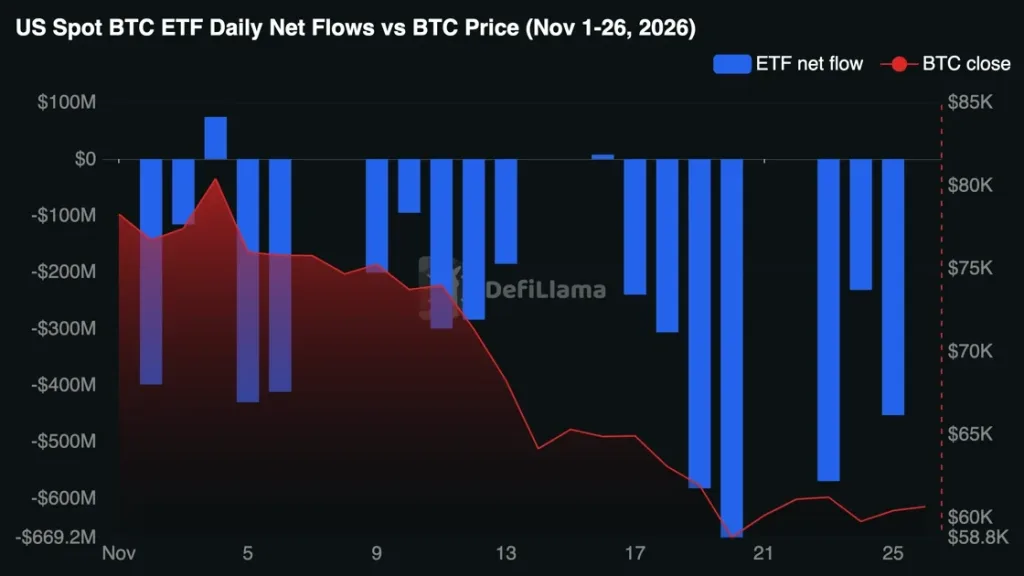
- Bitcoin ETF outflows reached a record $5.39 billion in November, Sentora data shows.
- Ethereum ETFs lost $1.30 billion in November, their third-largest monthly outflow.
- BTCS raised $43.8 million from Ether sales to repay its outstanding loans on Aave.
U.S. spot Bitcoin ETFs recorded their largest monthly outflows since launching in January 2024, with investors withdrawing a net $5.39 billion in November 2026. Ethereum ETFs lost another $1.30 billion during the month as cryptocurrency prices continued to fall. The market downturn also extended into decentralized finance (DeFi), where corporate borrowers sold Ethereum to settle outstanding debt.
BlackRock Leads the Record Bitcoin ETF Withdrawals
November’s withdrawals exceeded the previous monthly record of $4.51 billion in June by nearly 20%, figures from Sentora show. Bitcoin ETFs have now recorded $5.02 billion in net outflows since the beginning of 2026. That marks a reversal from 2024 and 2025, when the funds attracted $35.24 billion and $21.37 billion, respectively.
Sources: Sentora Research
Much of the recent selling came from BlackRock’s iShares Bitcoin Trust (IBIT). On November 19, the fund accounted for approximately 93% of the $582.3 million that investors pulled from U.S. spot Bitcoin ETFs.
Withdrawals continued on November 23, reaching $569.7 million and extending the redemption streak to five consecutive trading sessions. IBIT accounted for $509.3 million of that total.
Bitcoin has lost 22% of its value in November, with recent trading ranging between $57,600 and $60,500. A return to the $58,000 level on November 25 triggered $110 million in leveraged long liquidations.
Ethereum ETF Losses Mount as Extreme Fear Grips Markets
Ethereum investment products have fared little better. Their $1.30 billion in November withdrawals represents the third-largest monthly outflow since U.S. spot Ether ETFs began trading.
BlackRock’s iShares Ethereum Trust (ETHA) accounted for the entire $68.51 million in net outflows on November 25. The session marked the ninth consecutive trading day of withdrawals across Ethereum ETFs.
The combined net assets of these funds fell from $13.18 billion to $8.869 billion during November. Over the same period, Ether slipped into the 1,650–1,700 trading range, bringing its year-to-date losses to 42.7%.
Market sentiment has weakened alongside prices. Alternative.me’s Crypto Fear & Greed Index has remained within the “Extreme Fear” category since November 13, reaching a low of 12 on November 20. CoinMarketCap recorded an even lower reading of 10 out of 100 that day, while Alternative.me registered another reading of 13 on November 25.
Related: Bitcoin and Tokenized Gold Trading Tracks Euro Debt Costs
How are Crypto Companies Responding to Falling Prices?
The losses have extended beyond spot markets. On November 25, the CoinDesk DeFi Select Index fell 2.6%, compared with declines of 1.2% for Bitcoin and 2.2% for Ethereum.
Across DeFi, value locked is currently worth around $71 Billion and is being affected by both falling collateral prices and corporates repaying loans. In November 20, BTCS disposed of around 27,300 ETH for an average price of $1,604. It used these funds to repay loans that it had taken out on Aave.
Having sold this amount of ETH, BTCS now owns 24,245 ETH, representing a 53% reduction. The business still owes $10.5 million. Bit Digital too has used its ETH to pay Galaxy $50 million. Its loan debt has therefore been halved in this way.
In addition to the above loan repayments, Sentora research notes that institutions are increasingly investing in digitalized treasury and physical asset vehicles.
Typically, such investments are not included within TVL statistics for DeFi. Furthermore, in both crypto and decentralized finance, larger DeFi protocols continue to dominate—as smaller platforms struggle with limited liquidity.