Gold and Silver Plunge as December Fed Rate Hike Bets Grow

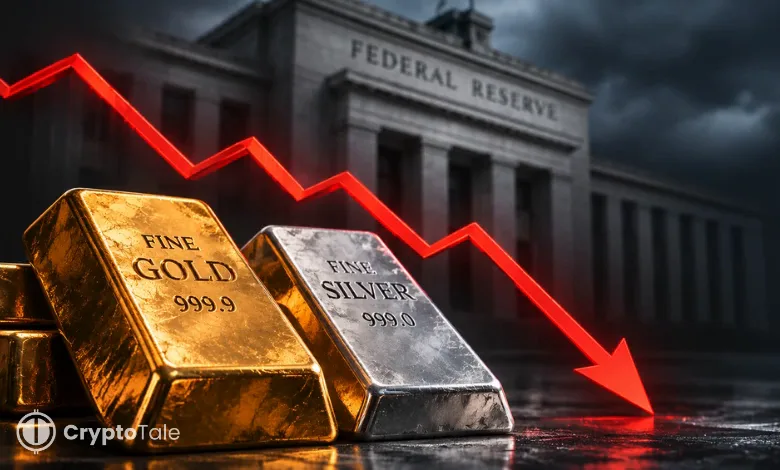
- Gold trades at $3,738.58 after falling over 30% from its January peak near $5,600.
- Silver has shed roughly 60% from its January peak of $121.65 to trade near $45.28.
- The 10-year US bond yield nears 5% as traders fully expect a December Fed rate hike.
Gold and silver prices fell to their lowest levels in more than a year on Monday as a stronger US dollar and rising bond yields weighed on demand. Expectations of another Federal Reserve rate hike in December have added to the pressure, leaving gold on course for its biggest annual decline since 2015.
Both metals recovered from their recent lows on Thursday, November 19, although the gains did little to offset months of losses. Gold traded at $3,738, while silver changed hands at $45.2795.
Gold and Silver Extend Losses From January Records
The sell-off marks a sharp reversal from January, when gold reached a record of nearly $5,600 an ounce, and silver climbed to $121.65. Gold has since lost more than 30% from its peak, bringing its losses this year to over 10%.
Silver has fared worse. The metal has shed roughly 60% of its value from January’s record and remains about 34% lower since the beginning of the year.
CoinMarketCap data showed gold trading 0.03% lower on Thursday, with its market capitalization slipping 0.14% to $25.23 trillion. Its 52-week trading range stood between $1,960 and $5,590.
Gold had approached $3,790 during the previous 24 hours before falling through $3,750. Prices briefly recovered overnight, but another bout of selling around 6:00 a.m. pushed gold toward $3,700.
In the tokenized gold market, the average price stood near $3,720. Market capitalization fell 0.89% to $4.55 billion, even as daily trading volume rose 7.31% to $362.13 million.
Why Are Gold and Silver Falling Despite Geopolitical Risks?
Much of the pressure comes from changing expectations for US monetary policy. The Federal Reserve raised interest rates in September for the first time since 2023, and traders now fully expect another increase in December, CME Group’s FedWatch tool showed.
Gold pays no interest, making it less attractive when investors can earn higher returns from bonds and savings. The yield on 10-year US government bonds has climbed to around 5%.
At the same time, the dollar reached its highest level since April 2025 on Tuesday, making precious metals more expensive for buyers using other currencies.
Even the war in Iran has offered Gold little relief. The conflict drove oil prices higher, adding to inflation and strengthening expectations that the Federal Reserve would raise borrowing costs again.
The reversal in precious metals began in January amid growing geopolitical tensions in Venezuela and Iran and President Donald Trump’s decision to nominate Kevin Warsh to lead the Fed.
Related: Kiyosaki Doubles Down on Gold, Silver, Bitcoin, and Ethereum
Silver Falls Toward $44 as Months of Selling Take Their Toll
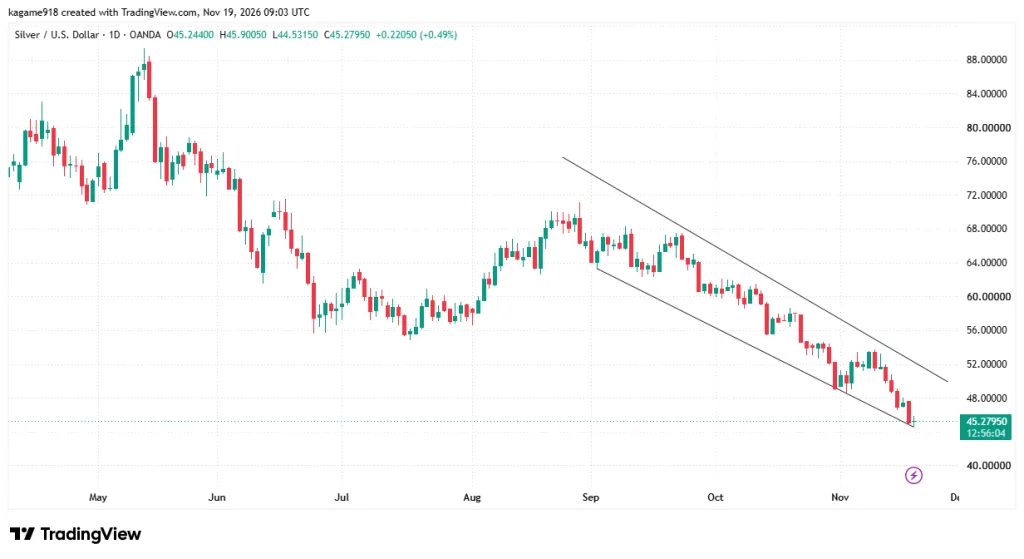
Silver’s daily chart shows how steadily the metal has lost ground since May, when prices approached $89. By July, silver had fallen toward $56 before recovering to nearly $70 in August. That recovery did not last. Silver entered a descending channel and gradually lost the $64, $60 and $56 levels throughout September and October as successive rallies stalled below previous highs.
Source: TradingView
Selling intensified in November after silver failed to sustain a recovery above $52. The metal subsequently slipped below $48, bringing Silver’s price close to the channel’s lower boundary.
Thursday’s session brought some relief, with silver gaining 0.49%, or $0.2205, to trade at $45.2795. Prices opened at $45.244 and reached $45.9005 after touching an intraday low of $44.5315.